
Last updated: 2026-04-25
A safety intelligence platform is an AI-powered system that continuously detects unsafe acts and conditions using existing cameras, automates safety workflows, delivers site-specific micro-training, and predicts preventable risk events before they occur. Unlike traditional EHS software, it closes the loop from detection to prevention in real time.
Introduction
Safety leaders have spent a decade digitizing incident reports, compliance checklists, and audit logs. Yet many VP EHS and Plant Managers watch incident rates plateau while teams drown in administrative work. The problem is not a lack of data — it is a lack of intelligence.
Traditional EHS software excels at recording what happened: near-misses, OSHA reports, training records. But it cannot see hazards as they emerge, automate responses, or predict the next incident. Meanwhile, insurance premiums rise, underwriters demand proactive risk evidence, and frontline workers disengage from generic training.
That gap is why safety leaders are searching for a Safety Intelligence Platform that turns existing cameras into live, actionable prevention. This guide defines what a safety intelligence platform is, how it differs from EHS tools, and how to evaluate whether your organization is ready to shift from reactive reporting to proactive protection.
What Is a Safety Intelligence Platform?
A safety intelligence platform is a unified system that transforms how industrial operations identify, respond to, and prevent workplace hazards. Instead of manual observations and after-the-fact reporting, it uses computer vision, workflow automation, and predictive analytics to create a continuous, closed-loop safety system.
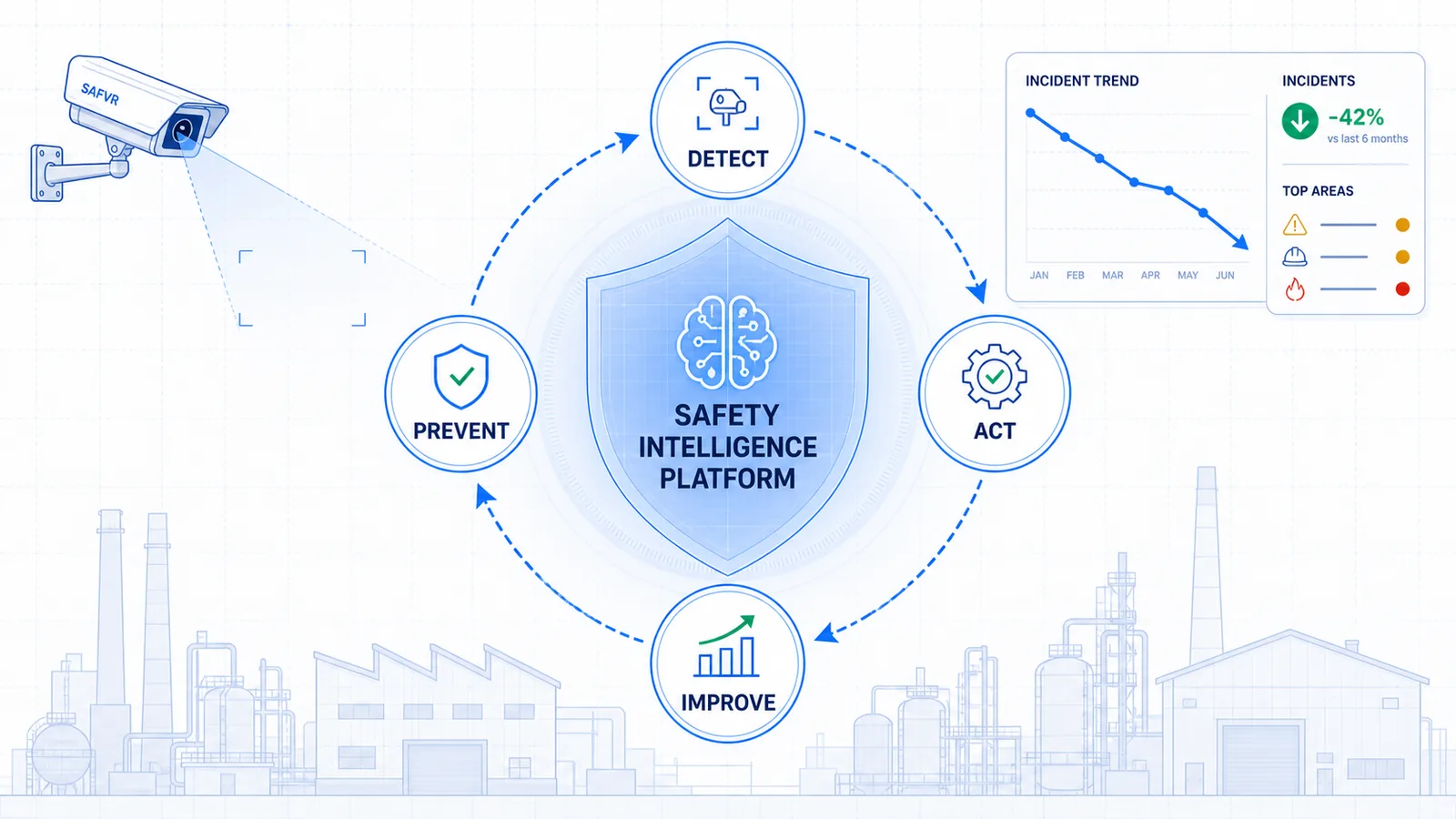
At SAFVR, this is powered by AURA (Autonomous Unified Recognition & Action) Engine — an adaptive safety intelligence platform. AURA runs a continuous four-phase cycle:
Real-Time Detection — Connects to existing IP cameras to detect unsafe acts and conditions, PPE violations, and environmental hazards as they happen. No rip-and-replace required (customer-reported).
Automated Action — Triggers alerts, assigns corrective actions, and updates permit-to-work systems automatically. Safety teams spend less time on manual follow-up (pilot benchmark).
Site-Specific Improvement — Generates micro-training modules from actual incidents at that facility. Workers receive short, targeted instruction in their own language (anonymized deployment).
Predictive Prevention — Correlates data across shifts, sites, and time periods to surface leading indicators and risk patterns humans cannot spot manually. Produces structured risk-review reports (anonymized deployment).
The result is Site-Specific Safety Intelligence: a system that adapts to your facility's unique risks, layout, and operational rhythm.
Safety Intelligence Platform vs Traditional EHS Software
The distinction is philosophical. EHS software documents compliance. Safety intelligence prevents incidents.
| Capability | Traditional EHS Software | Safety Intelligence Platform |
|---|---|---|
| Data Collection | Manual entry, forms, periodic audits | Continuous computer vision from existing cameras |
| Speed of Insight | Days or weeks after an incident | Real-time detection and alerting |
| Action Mechanism | Human-initiated workflows and reminders | Automated alerts, assignments, and compliance actions |
| Training Delivery | Scheduled classroom or generic LMS modules | Site-specific micro-training triggered by actual events |
| Reporting Focus | Lagging indicators: incidents, injuries, compliance scores | Leading indicators: near-miss patterns, predictive risk scores |
| Implementation | Months-long configuration and change management | Works with existing IP cameras; typically live in days (pilot benchmark) |
| Primary Outcome | Regulatory compliance and record-keeping | Proactive prevention and measurable risk reduction |
If your system produces excellent incident reports but does nothing to stop the next incident, you are using documentation software — not intelligence.
The Four Pillars of Safety Intelligence
Every true safety intelligence platform is built on four interconnected capabilities. At SAFVR, these are the phases of AURA:
1. DETECT — See What Manual Inspections Miss
The AI hazard detection layer uses existing IP cameras to monitor work areas continuously, identifying unsafe acts and conditions in real time without a rip-and-replace deployment.
2. ACT — Turn Detections into Accountable Actions
Detection without action is just noise. The safety compliance automation layer converts every detection into a trackable workflow: alerts, assignments, permit-to-work updates, and escalations.
3. IMPROVE — Train from Reality, Not Generic Content
Traditional safety training is scheduled. Safety intelligence is triggered. The incident-based micro-training layer generates short modules from actual events at that site, delivered in multiple languages. Workers learn the specific risks they face today.
4. PREVENT — Stop Incidents Before They Start
The predictive safety intelligence layer correlates data across time, shifts, and locations to surface leading indicators. Instead of reacting to last month's injury report, safety leaders see where the next incident is likely to occur.
These four pillars form a closed loop: detection feeds action, action feeds improvement, and improvement feeds prevention. That loop separates safety intelligence from every other category of safety technology.
Ready to see the loop in action? Start a 30-day safety intelligence pilot and see how your existing cameras become a proactive prevention system.
Who Needs a Safety Intelligence Platform?
Not every organization is ready for safety intelligence. But if you recognize yourself in any of these profiles, the shift is likely overdue:
VP EHS / Safety Director Your incident rate has plateaued despite process improvements. You need to prove continuous improvement to leadership and underwriters, not just compliance to regulators. Manual reporting consumes the time you need for strategic prevention.
Plant / Operations Manager You own uptime and output. Safety incidents disrupt production, yet your current system only tells you what went wrong yesterday. You need live risk visibility before a stoppage — without installing new hardware across every line.
Training / HR Leader Training completion rates are high, but behavioral change is low. Workers go through the motions because content is generic. You need training that adapts to actual site conditions and speaks workers' own languages.
CFO / Risk and Insurance Leader Insurance premiums are rising despite a clean compliance record. Underwriters want proactive risk evidence, not lagging incident data. You need leading-indicator reports that justify continued safety investment.
If more than one of these roles shares your inbox, the business case for safety intelligence already exists.
How to Recognize a True Safety Intelligence Platform
When evaluating vendors, look for these capabilities that define a genuine safety intelligence platform:
- Works with existing IP cameras — No proprietary hardware or rip-and-replace installation. Connects to current infrastructure and is live within days (pilot benchmark).
- Real-time detection of unsafe acts and conditions — Identifies hazards as they occur, not after a scheduled audit. Continuous monitoring is the baseline.
- Automated workflow engine — Alerts trigger actions, assignments, and escalations without a human routing every notification.
- Closed-loop architecture — Detection feeds action, action feeds training, and training feeds prevention. Point solutions are not intelligence platforms.
- Site-specific adaptation — Learns the unique risks, layout, and conditions of your facility rather than applying one-size-fits-all rules.
- Underwriter-ready leading indicator reports — Generates evidence of proactive risk reduction that insurance partners accept as credible (anonymized deployment).
- Multilingual training delivery — Site-specific micro-training accessible in the languages your workers actually speak.
Vendors that check fewer than five of these boxes are selling detection software, not a true safety intelligence platform.
The Business Case for Safety Intelligence
Safety intelligence is a risk reduction strategy with measurable financial returns:
Reduced Incident Rates Sites that replace reactive reporting with continuous detection see measurable reductions in preventable events. SAFVR pilot facilities have reported up to a 60% reduction in targeted unsafe acts and conditions within 90 days (pilot benchmark). Every prevented incident saves medical costs, workers' compensation, and regulatory exposure.
Lower Insurance and Underwriting Costs Underwriters differentiate between organizations that record incidents and those that prevent them. Safety intelligence platforms produce leading-indicator data — detection frequency, response times, and corrective action completion — that underwriters accept as evidence of proactive risk management (anonymized deployment). Several SAFVR customers have used these reports to support premium negotiations.
Elimination of Manual Administrative Work Safety teams often spend 15 to 20 hours per week on manual data entry and follow-up routing (illustrative example). Automated detection and workflow engines eliminate that overhead, freeing safety professionals for root-cause analysis.
Avoided Downtime and Operational Disruption A single serious incident can trigger regulatory inspections and production halts. The direct and indirect cost of a preventable serious incident in industrial operations typically ranges from $50,000 to $150,000 (illustrative example). Preventing even one such event per year often covers the platform investment.
Improved Training Efficiency Generic training shows diminishing returns. Site-specific micro-training delivered immediately after a detection reinforces correct behavior when it matters. Pilot participants report higher engagement and retention than classroom sessions (pilot benchmark).
Frequently Asked Questions
What is the difference between a safety intelligence platform and EHS software?
EHS software documents compliance, manages incident records, and generates regulatory reports after events occur. A safety intelligence platform uses AI and live data to detect hazards in real time, automate responses, and predict future incidents. It shifts the focus from recording history to preventing it.
Can a safety intelligence platform work with existing cameras?
Yes. A true safety intelligence platform connects to your existing IP camera infrastructure without requiring a rip-and-replace deployment. At SAFVR, the detection layer integrates with standard camera networks and is typically operational within days (customer-reported).
How does AI improve workplace safety compared to manual inspections?
Manual inspections are periodic, subjective, and limited by human attention span. AI-powered detection operates continuously, identifies patterns across thousands of hours of footage, and never fatigues. It does not replace safety professionals — it gives them complete visibility to intervene earlier and more effectively.
What industries benefit most from safety intelligence platforms?
Safety intelligence platforms deliver the strongest results in industrial environments with visible hazards and existing camera infrastructure: manufacturing, warehousing, oil and gas, chemicals, construction, and heavy industry. Any operation where PPE compliance and environmental hazards are daily concerns is a strong candidate.
How long does it take to implement a safety intelligence platform?
Implementation varies by facility size, but a platform using existing camera infrastructure can typically be live in days, not months. The 30-day pilot model lets organizations validate detection accuracy and workflow automation before a full deployment (pilot benchmark).
Conclusion
The shift from EHS software to a safety intelligence platform is not about buying more technology — it is about changing the outcome. Industrial safety has been trapped in a reactive cycle: incident, report, review, repeat. A safety intelligence platform breaks that cycle by detecting hazards as they emerge, acting automatically, improving behavior through site-specific training, and preventing future incidents through predictive insight.
If your organization is ready to move from reactive reporting to proactive protection, explore the full Safety Intelligence Platform overview to see how AURA's four-phase loop works, or start your 30-day safety intelligence pilot and see the difference live on your floor.
Related Reading
- How to Evaluate a Safety Intelligence Platform — A 10-capability buyer’s scorecard for comparing platforms before you commit.
- Safety Intelligence Pilot ROI Methodology — The 4-dimension framework for measuring safety platform ROI across safety, ops, compliance, and insurance.
- AI Hazard Detection with Existing Cameras — How the detection layer of a safety intelligence platform works with your current camera infrastructure.