
Last updated: April 25, 2026
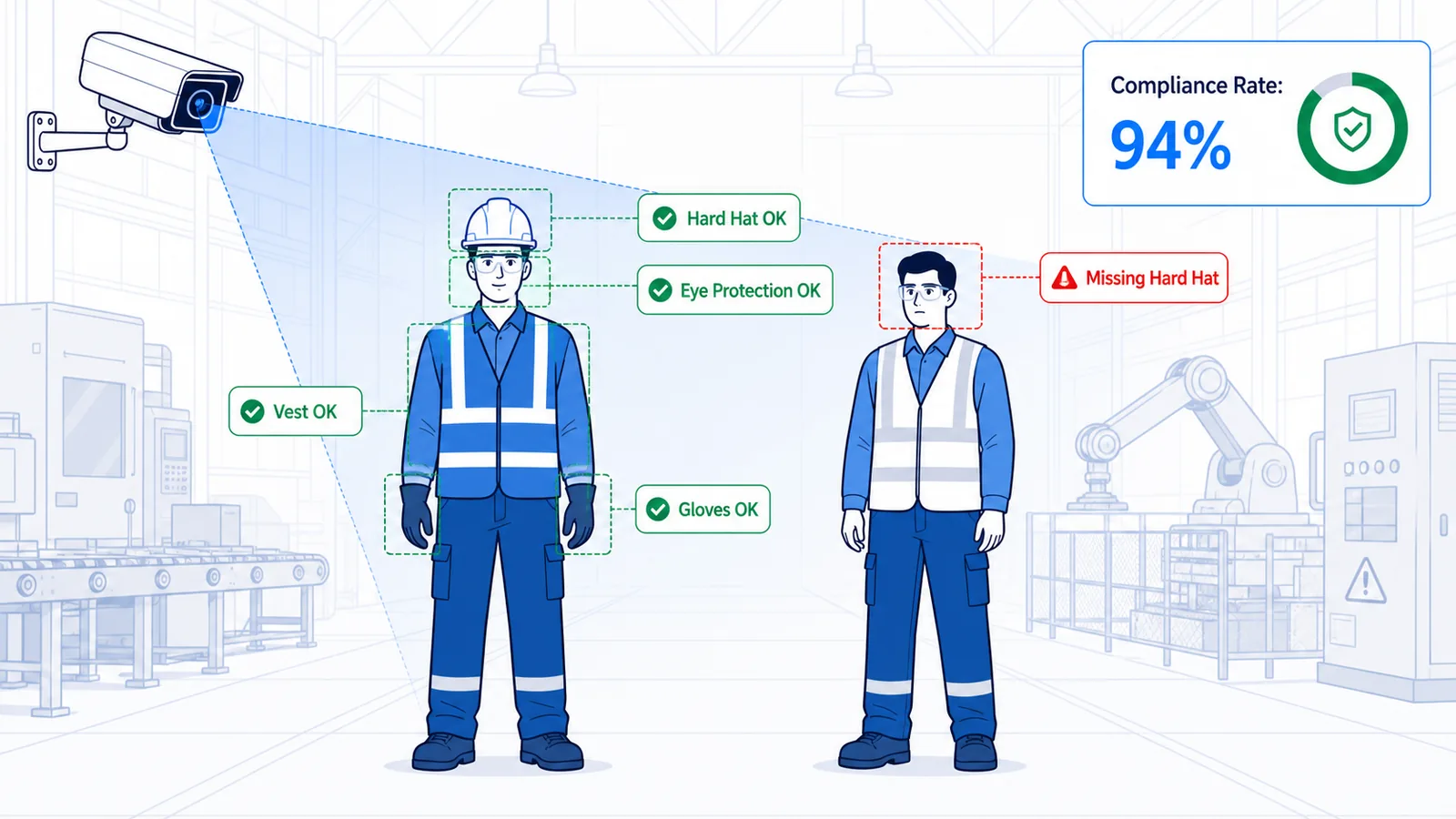
PPE detection AI uses computer vision and existing IP cameras to monitor whether workers are wearing required safety gear — hard hats, safety vests, gloves, eye protection — in real time. When a violation is detected, the system triggers alerts, automates compliance workflows, and generates site-specific training to prevent recurrence. It works with your current camera infrastructure and is designed to support — not replace — your frontline safety teams.
Every year, thousands of workplace injuries trace back to one preventable cause: missing or improperly worn personal protective equipment. The U.S. Bureau of Labor Statistics reports over 2.6 million nonfatal workplace injuries and illnesses in the private sector in 2023 (third-party statistic) — a significant share involving PPE gaps.
For safety officers and plant managers, PPE enforcement has long been manual and sporadic. Rounds are limited by staffing hours. Spot checks catch only a fraction of violations. When something goes wrong, the response is reactive: file a report, assign training, hope it doesn't happen again.
PPE detection AI changes the equation. By applying computer vision to existing facility cameras, it creates continuous, real-time safety visibility — detecting violations as they happen, triggering immediate action, and feeding a closed-loop improvement system. This is Site-Specific Safety Intelligence: technology that adapts to your facility's risks, layout, and conditions rather than forcing a generic template onto complex operations.
In this guide, we'll break down how PPE detection AI works, what it can detect, and what operations leaders should know before deploying it.
What Is PPE Detection AI?
PPE detection AI is a computer vision application that analyzes live video feeds from industrial cameras to identify whether workers are wearing required protective equipment. It falls under the broader category of AI hazard detection — using trained machine learning models to recognize objects, patterns, and conditions in a physical environment.
The technology operates in four stages: Camera Input (video from existing IP cameras), Object Detection (models locate people and classify worn PPE), Rule Matching (detected PPE is compared against site-specific safety rules), and Alert Generation (violations trigger real-time notifications to supervisors).
The key advantage is Live Site Intelligence: continuous compliance visibility across every camera-covered zone. Because modern systems work with existing infrastructure, deployment timelines shrink from months to weeks — critical for operations leaders who cannot afford production downtime.
Ready to see real-time PPE detection in action? Start a 30-day safety intelligence pilot and see how your existing cameras become active safety sensors.
8 Types of PPE AI Can Detect
Modern AI PPE detection software can be trained to recognize a wide range of protective equipment. The table below covers the most commonly detected items across industrial deployments:
| PPE Type | What AI Detects | Typical Deployment Zones |
|---|---|---|
| Hard Hats / Helmets | Presence, color, chin-strap position | Construction zones, manufacturing floors, mining operations |
| Safety Vests / High-Visibility Clothing | Vest presence, reflective strip visibility, color class | Warehouses, logistics yards, roadwork sites |
| Safety Glasses / Goggles | Eye protection presence, tinted vs. clear | Machine shops, chemical handling, grinding areas |
| Gloves | Hand coverage, glove type (cut-resistant, chemical) | Assembly lines, material handling, maintenance bays |
| Steel-Toe Boots / Safety Footwear | Footwear type, ankle coverage | Heavy manufacturing, construction, warehousing |
| Hearing Protection | Earplugs or earmuffs in place | Foundries, printing facilities, aircraft maintenance |
| Face Shields / Respirators | Facial coverage, respirator cartridge type | Welding stations, painting booths, pharmaceutical cleanrooms |
| Fall Protection / Harnesses | Harness worn, clipped to anchor point | Roofing, scaffolding, elevated platforms |
Detection accuracy varies by item. Hard hats and safety vests — large, high-contrast objects — typically achieve the highest detection rates. Smaller items like earplugs or partially occluded gloves present greater technical challenges, which we'll address later.
How PPE Detection Works in Real Time
Understanding the technical process helps operations leaders evaluate vendors and plan deployment. Here's the real-time PPE monitoring pipeline:
Step 1: Video Ingestion. Cameras stream video to an edge device or cloud layer. Modern Safety Intelligence Platforms use edge computing to process footage locally — reducing bandwidth costs and keeping sensitive footage within your network.
Step 2: Person Detection. The model identifies human figures in each frame. This is challenging where workers may be partially obscured by machinery, carrying large objects, or wearing bulky gear.
Step 3: PPE Classification. The model runs a secondary classification pass on body regions: head for hard hats, torso for vests, hands for gloves, feet for boots. Each region is scored independently.
Step 4: Rule Engine Evaluation. The system checks classified PPE against site-specific rules: welding bays require face shields; logistics yards require high-visibility vests. Leading platforms allow safety officers to define zones and shifts visually — no coding required.
Step 5: Alert and Action. Violations trigger alerts. Basic tools send dashboard notifications; advanced platforms route zone-specific alerts to the nearest supervisor, create timestamped compliance records, and initiate permit-to-work holds.
SAFVR's AURA (Autonomous Unified Recognition & Action) Engine — an adaptive safety intelligence platform — runs this as part of a continuous loop: DETECT → ACT → IMPROVE → PREVENT. PPE detection is the DETECT phase. What happens next is where real operational value is created.
Beyond Detection: The Full Response Workflow
Detecting a missing hard hat is useful. Automatically ensuring it never happens again is transformative. Here's the full response workflow in a closed-loop Safety Intelligence Platform:
Alert → Supervisor Action
When a violation is detected, the system sends a real-time alert to the assigned supervisor — via mobile app, SMS, or integrated platform — with camera location, timestamp, and a still image. The supervisor addresses it immediately: correct the worker, verify the condition, mark the alert resolved.
This replaces discovering violations during end-of-shift paperwork review — when it's too late to prevent the incident.
Action → Compliance Record
Every detection and resolution is logged automatically, creating an auditable trail for internal reviews, insurance documentation, and regulatory reporting. For CFOs and risk managers, this turns safety activity into structured leading-indicator reports.
Training Assignment
Instead of generic annual refreshers, the system generates site-specific micro-training from actual events. A worker who missed safety glasses in Zone 3 receives a 3-minute targeted module — in their preferred language, referenced to the actual near-miss.
This is the IMPROVE phase of AURA. Over time, the PREVENT layer correlates patterns across sites, shifts, and seasons — surfacing predictive risk patterns that stop incidents before they start.
Learn more about the full detection-to-prevention loop: Explore AI hazard detection and automated safety workflows.
PPE Detection by Industry
PPE requirements and deployment contexts vary significantly across sectors:
Manufacturing. Assembly lines require gloves and safety glasses; maintenance bays add hard hats and steel-toe boots; chemical areas require respirators. AI enables zone-specific rule enforcement and identifies which shifts show recurring compliance gaps.
Construction. Dynamic environments where zones change daily. Workers move between excavation, scaffolding, and interior work — each with different PPE. Mobile cameras extend coverage to areas without fixed infrastructure. Hard hat detection AI is the most mature use case here.
Oil & Gas. Flame-resistant clothing, gas detection badges, hard hats with face shields, and platform harnesses are required. Real-time monitoring supports OSHA Process Safety Management compliance and demonstrates proactive safety culture to auditors and underwriters.
Warehousing & Logistics. High-visibility vests, steel-toe boots, and voice-picking headsets define the landscape. With high turnover, consistent enforcement is challenging. Automated detection provides scalable safety coverage independent of supervisor-to-worker ratios.
Addressing Privacy and Worker Concerns
Any technology that watches workers raises legitimate questions. Responsible deployment requires transparency, ethical design, and respect for frontline personnel.
What the System Does — and Doesn't Do
PPE detection AI recognizes equipment, not individuals. Models are trained on hard hats and vests, not faces or biometric signatures. Well-architected systems flag violations at a location and time — not "John Smith failed to wear his gloves."
Camera placement matters: capture work zones, not break rooms. Configure alerts as conditions — "Zone 4, missing hard hat" — rather than broadcasting worker-specific imagery.
Data Handling and Retention
Best-practice deployments retain footage 30 to 90 days using encrypted storage with role-based access. Workers should be informed about camera locations and how data is used. Workers who see the system as protective, not punitive, engage more constructively.
Include safety committees in deployment planning. Their input on camera placement and alert thresholds improves system design and organizational trust.
Accuracy, False Positives, and Edge Cases
No AI system is perfect. PPE detection accuracy depends on environmental conditions, camera quality, and equipment complexity. Operations leaders should evaluate vendors with clear eyes:
Lighting Conditions. Low light, harsh shadows, and glare from welding arcs can degrade performance. Infrared cameras improve nighttime coverage but add cost. Highest accuracy typically occurs in well-lit indoor environments.
Occlusion. When workers carry large objects or stand behind equipment, PPE can be partially hidden. Models handle partial occlusion well for large items like hard hats. Small items like earplugs are significantly harder.
False Positives. Flagging compliant workers as non-compliant erodes trust. Quality systems allow sensitivity tuning and feedback to retrain models on site-specific conditions. Expect a 2–4 week calibration period.
Edge Cases. Workers with religious head coverings (managed through rule exceptions), temporary workers in mixed PPE, outdoor weather changes, and new PPE vendors with different colors all require thoughtful handling.
The honest answer: PPE detection AI is a powerful component of a comprehensive safety program, not a standalone solution. It works best paired with supervisor judgment and a feedback loop that continuously improves accuracy.
Frequently Asked Questions
What cameras work with PPE detection AI?
Most systems work with standard IP cameras using ONVIF or RTSP protocols. SAFVR's platform integrates with existing infrastructure — no rip-and-replace required. Resolution, frame rate, and positioning affect accuracy; a brief site assessment identifies whether upgrades are needed.
How long does deployment take?
A pilot can be operational in 2–4 weeks. Full-facility rollouts typically take 6–12 weeks, including rule configuration and calibration. Learn about our 30-day safety intelligence pilot.
Does PPE detection AI comply with privacy regulations?
When deployed responsibly, yes. Key practices include avoiding cameras in private areas, limiting retention, encrypting footage, restricting access, and informing workers about monitoring scope. The system detects equipment, not identities via facial recognition. Consult your legal and HR teams for jurisdiction-specific requirements.
Can the system detect PPE quality — e.g., a cracked hard hat?
Current systems detect presence and type reliably. Detecting condition — cracks or wear — requires higher-resolution cameras and specialized models. This capability exists in advanced deployments but is less mature than basic presence detection.
How does PPE detection fit into a broader safety strategy?
PPE detection is one component of a Safety Intelligence Platform. It feeds analytics that identify leading indicators: recurring zones, shift patterns, and training effectiveness. This is the shift from reactive reporting to proactive protection. Explore the full platform.
Conclusion
PPE non-compliance is an operational visibility problem, not a worker discipline problem. When safety officers can only inspect a fraction of zones, violations become inevitable. PPE detection AI closes that gap by turning existing cameras into continuous, real-time safety sensors.
The technology has matured. Hard hat detection AI, safety vest recognition, and glove monitoring are deployable today with accuracy that justifies operational investment. But the real value isn't detection — it's what comes after. Alerts that reach the right person at the right time. Compliance records that satisfy underwriters. Training that targets actual gaps. And predictive insights that stop tomorrow's incident before it happens.
That's Site-Specific Safety Intelligence: not watching workers, but protecting them.
Ready to transform your safety program?
Start your 30-day safety intelligence pilot →
See how AI hazard detection works →
Explore the full SAFVR platform →
Related Reading
- AI Hazard Detection with Existing Cameras — Beyond PPE: how the same camera infrastructure detects slip risks, exclusion zone breaches, and equipment proximity hazards.
- Construction Safety AI Guide — PPE enforcement on dynamic construction sites with rotating subcontractor crews.
- Warehouse & Logistics Safety AI — PPE compliance challenges in high-velocity fulfillment centers with seasonal workforce surges.