
Evidence-Led Safety Operations Across the Energy Sector.
Oil & gas, power generation, transmission & distribution, renewables, and energy storage — unified safety intelligence for permits, confined space, LOTO and arc-flash, and contractor competency.
Energy operations span the highest hazard profiles in industry — from upstream wells and refineries to thermal, nuclear, and hydro plants, transmission substations, wind farms, solar fields, and battery storage. Every sub-sector shares the same hazard families: hot work, confined space, working-at-height, hazardous energy isolation, arc flash, H₂S and gas leaks, and rotating contractor populations. SAFVR's AURA engine provides unified safety intelligence across distributed energy sites — detecting hazards in real time, automating permit-to-work and compliance workflows, training contractors on site-specific protocols, and predicting where risk is accumulating.
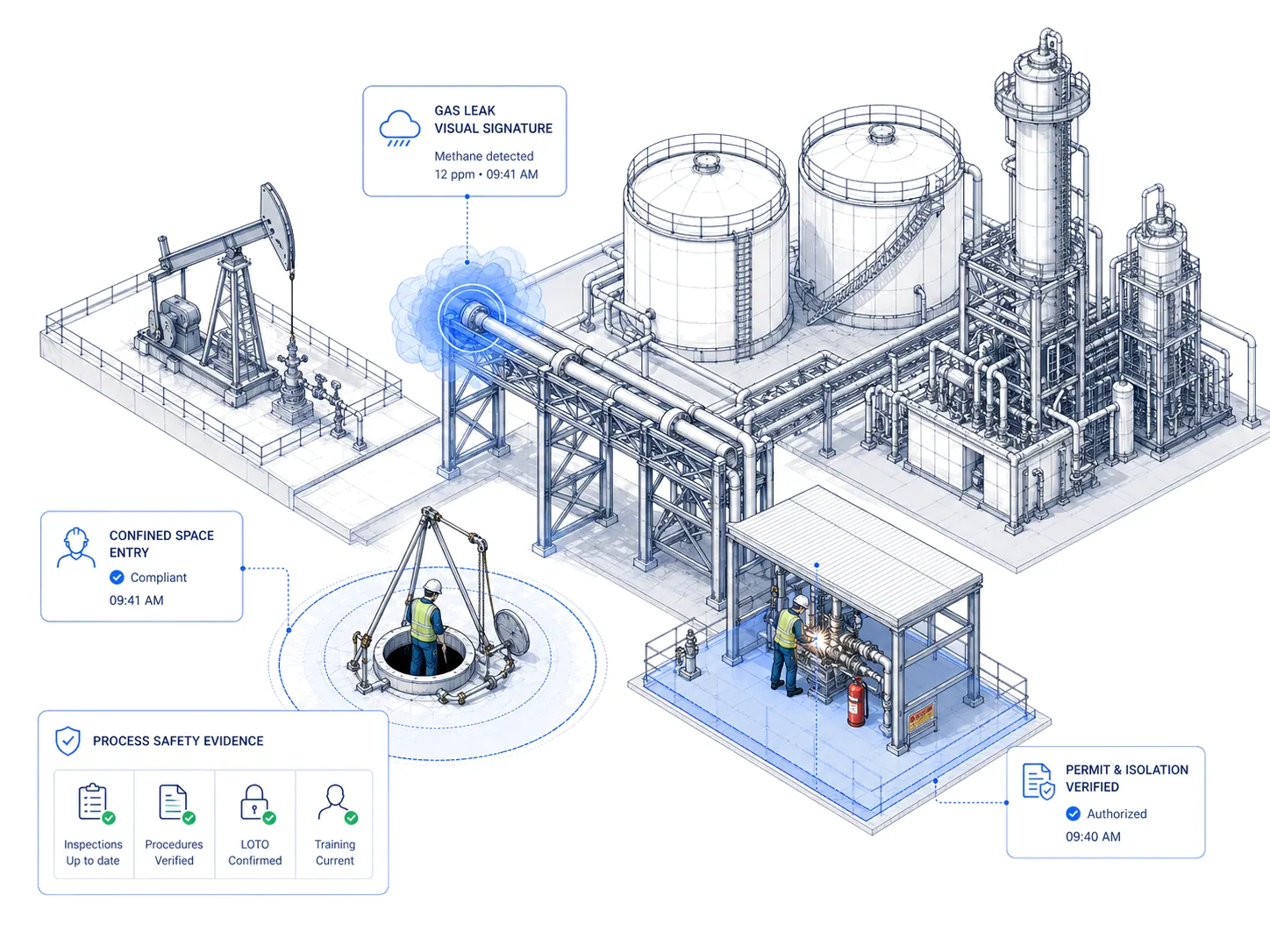
What Energy Safety Leaders Face Today.
- 01
Remote & Hazardous Sites
Offshore platforms, remote wellheads, substations, wind farms, and confined-space environments — limited connectivity, extreme consequence if something goes wrong.
- 02
Regulatory Overlap
Multi-jurisdictional compliance (OSHA, BSEE, EPA, NERC, FERC, OSHA 1910.269 electrical, IEC, plus local regulators) that evolves independently across upstream, downstream, grid, and renewables.
- 03
Contractor Workforce Churn
Rotating contractors with varying competency levels, site familiarity, and safety cultures — the population most represented in incident data across oil & gas turnarounds, power plant outages, and utility line work.
Detect. Act. Improve. Prevent.
- 01 / DETECT
High-Hazard Environment Monitoring
Unified intelligence layer across distributed energy sites — monitoring hot work, confined space entry, PPE, arc-flash boundaries, LOTO compliance, and exclusion zones, even with intermittent connectivity.
Inside DETECT - 02 / ACT
Permit & Regulatory Auto-Mapping
Permit-to-work and regulatory changes auto-mapped to site-specific workflows — ensuring refineries, power plants, substations, and wind farms stay current without manual policy reviews.
Inside ACT - 03 / IMPROVE
Contractor Competency Training
Contractor-ready micro-training generated on-demand — multilingual, mobile-first, and calibrated to each site's hazard profile (H₂S zones, arc-flash boundaries, confined space, working-at-height).
Inside IMPROVE - 04 / PREVENT
Process & Electrical Safety Leading Indicators
AURA correlates permit compliance rates, contractor competency scores, near-miss patterns, and environmental conditions — forecasting process and electrical safety risk before events escalate.
Inside PREVENT
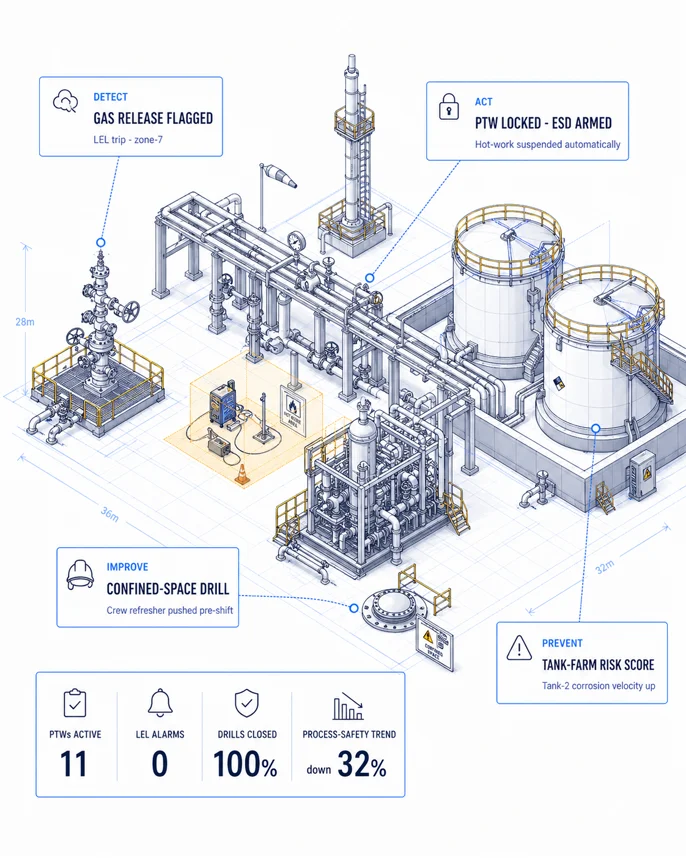
What Energy Pilots Measure.
Outcomes vary by camera coverage, baseline maturity, and workforce mix. Pilot results are measured per site over the 30-day deployment window.
Every System. Every Zone. One Platform.
Hot Work Permit Automation
AURA digitises the entire hot-work permit lifecycle — verifying atmospheric clearance, fire-watch presence, and PPE compliance via camera before activation, with every step timestamped for regulatory evidence across refineries, power plants, and substations.
Confined Space Monitoring
Vision AI tracks personnel entry, exit, and duration inside confined spaces — detecting unauthorised access, missing attendants, and PPE violations even in low-bandwidth offshore platforms, wind nacelles, and underground vault environments.
H₂S Detection Monitoring
AURA correlates camera-based personnel tracking with H₂S alarm zones, ensuring evacuation compliance and muster-point accountability when gas sensors trigger — closing the gap between detection and response on rigs, wellheads, and gas-processing facilities.
Arc-Flash & LOTO Verification
Camera-verified evidence that hazardous energy is isolated, lockout/tagout steps are completed, and arc-flash PPE (FR clothing, face shields, gloves) is worn before energized work begins — timestamped for OSHA 1910.269 and NFPA 70E audit readiness.
Process & Electrical Safety Intelligence
Leading indicators from permit compliance, near-miss patterns, contractor competency scores, and environmental conditions are correlated to forecast which sites and shifts are accumulating process or electrical safety risk before events escalate.
Contractor Safety Verification
Real-time verification that every contractor on site has completed induction, holds valid competency certifications, and is wearing correct PPE for their assigned zone and task — across turnarounds, plant outages, and utility line work.
Offshore & Renewables Safety Compliance
AURA supports BSEE, flag-state, and renewables (GWO, IECRE) regulatory frameworks with camera-verified evidence trails for permit-to-work, PPE, muster drills, and restricted-zone discipline across offshore platforms, FPSOs, and wind farms.
Common questions about SAFVR for energy.
- Which energy sub-sectors does SAFVR cover?
- Oil & gas (upstream, midstream, downstream/refining), power generation (thermal, nuclear, hydro, renewables), transmission & distribution utilities, substations, wind and solar farms, and battery/BESS facilities. The AURA engine is the same — hazard models, permit templates, and regulatory mappings are tuned per sub-sector.
- How does AURA automate hot work permits in refineries and power plants?
- AURA digitizes hot work permit issuance, verifies isolation and gas-test compliance via on-camera checks, and routes sign-offs to the responsible authority. Audit-ready evidence is generated automatically for every permit lifecycle — across refineries, power plant outages, and substation maintenance windows.
- Can AURA monitor confined space entries with intermittent connectivity?
- Yes. Edge processing keeps confined-space monitoring active during connectivity dropouts, with events queued and synced when the link returns — designed for offshore platforms, remote wellheads, wind turbine nacelles, and underground utility vaults.
- How does AURA support arc-flash and LOTO compliance in power and utilities?
- AURA visually verifies LOTO steps, energy-isolation lockouts, arc-flash boundary discipline, and required PPE (FR clothing, face shields, gloves) before energized work begins — every step timestamped for OSHA 1910.269 and NFPA 70E evidence.
- How does AURA handle multi-jurisdictional regulatory overlap?
- Regulatory changes are auto-mapped to each site's permit procedures and compliance checklists. Sites remain current without manual policy reviews, and audit trails are jurisdiction-tagged for OSHA, BSEE, EPA, NERC, FERC, and local regulator readiness.
- What proof does AURA provide of contractor competency?
- Contractor competency micro-training is delivered on-demand and logged per individual, per site, per scope. Verification of training completion is gated to permit issuance — no completion, no work authorization. Works for refinery turnarounds, power plant outages, and utility line crews alike.
- How does process safety intelligence forecast risk?
- AURA correlates permit compliance rates, contractor competency scores, near-miss patterns, and environmental conditions to surface process and electrical safety leading indicators — flagging which sites and shifts are accumulating risk before events escalate.
- Is SAFVR rated for use in hazardous (ATEX/IECEx) classified areas?
- SAFVR's edge processing and camera integration architecture is designed to support deployment in hazardous classified areas when paired with ATEX/IECEx-rated camera hardware. The platform itself runs on your existing infrastructure — consult your site's classification zone requirements during pilot scoping.
Inside the Loop & Adjacent Industries.
Make Prevention Evidence More Than a Slogan
Start a paid 30-day pilot. AURA deploys across your sites, adapts to your permit workflows, and measures workflow improvements for review.