Assembly Line Safety. Zero Defects.
Robot cell zone monitoring, ergonomic risk assessment, paint-shop PPE compliance, and IATF 16949 safety alignment — from body shop to final assembly.
Automotive manufacturing demands both worker safety and production quality — where a safety incident on the line is also a quality event. SAFVR's AURA engine monitors assembly line operations in real time, detects unsafe conditions around robot cells and hazardous processes, automates compliance workflows aligned with IATF 16949 requirements, delivers role-specific training, and predicts where ergonomic and safety risks are accumulating.
What Automotive Safety Leaders Face Today.
- 01
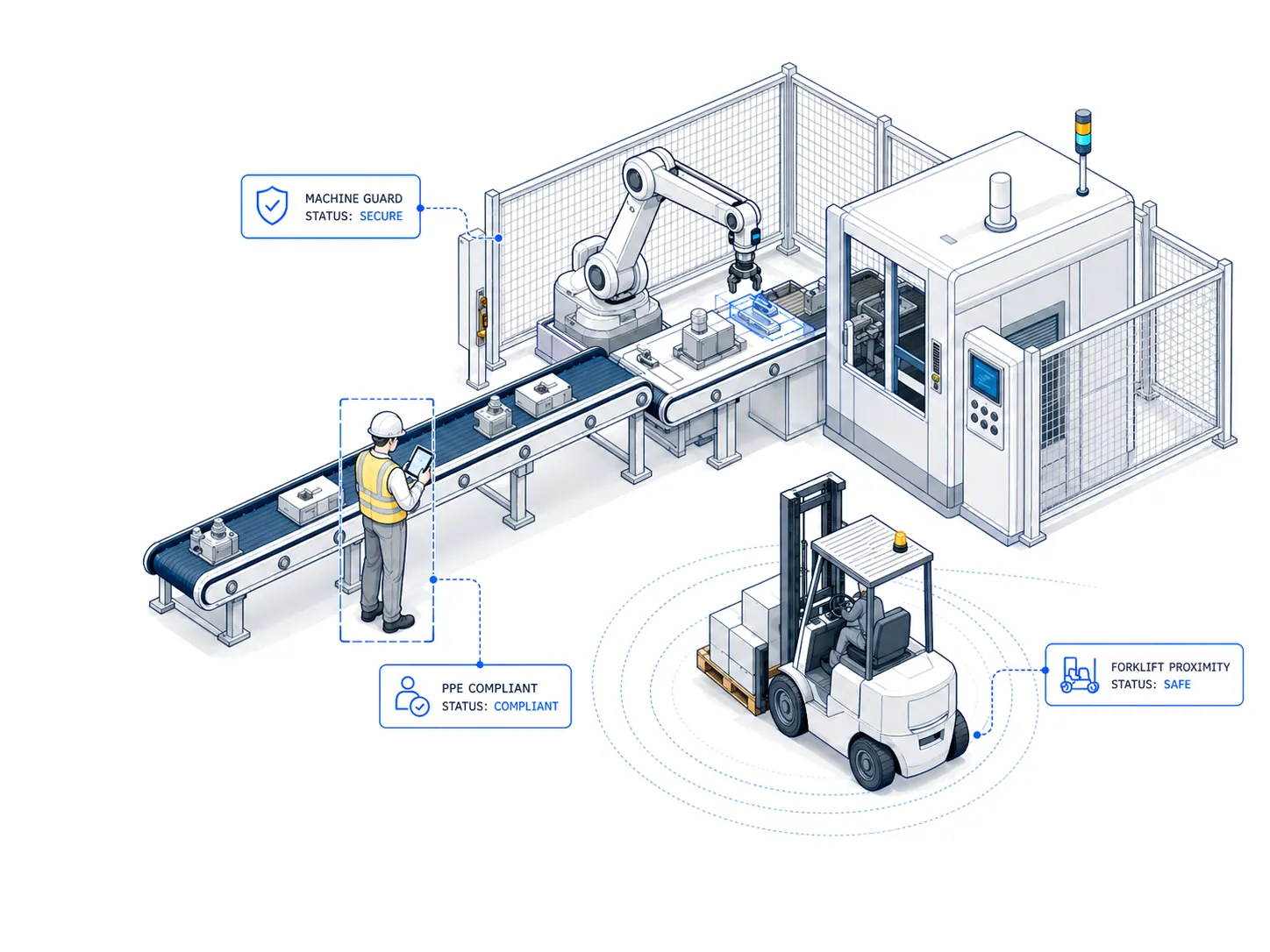
Human-Robot Interaction Zones
Workers operating alongside robotic systems in body shops, welding stations, and assembly cells with static guarding that can't adapt to every scenario.
- 02
Ergonomic Strain Accumulation
Repetitive assembly tasks generate cumulative musculoskeletal strain that traditional safety programs detect too late — after the injury, not before the risk.
- 03
IATF 16949 Safety Alignment
Automotive quality management standards require safety processes that integrate with production quality systems — most safety platforms operate in isolation.
Detect. Act. Improve. Prevent.
- 01 / DETECT
Assembly Line Hazard Monitoring
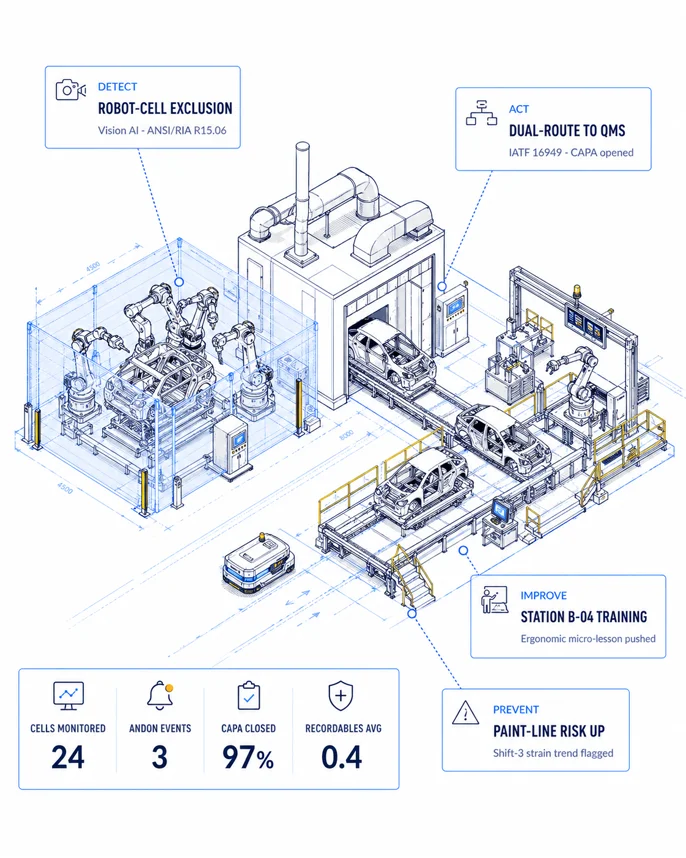
Vision AI monitors robot cell exclusion zones, ergonomic strain indicators, paint-shop PPE compliance, and hazardous material handling — calibrated to each station and process.
Inside DETECT - 02 / ACT
Production-Integrated Safety Workflows
Automated safety workflows that align with IATF 16949 quality management requirements — routing safety events to both safety and quality teams with integrated documentation.
Inside ACT - 03 / IMPROVE
Station-Specific Operator Training
Micro-training modules generated per assembly station — covering the exact ergonomic risks, PPE requirements, and safe operating procedures for each role and process.
Inside IMPROVE - 04 / PREVENT
Ergonomic & Process Risk Prediction
AURA tracks ergonomic strain patterns, station-specific incident trends, and corrective action effectiveness — forecasting which stations and shifts are accumulating risk before injuries manifest.
Inside PREVENT
What Automotive Pilots Measure.
Outcomes vary by camera coverage, baseline maturity, and workforce mix. Pilot results are measured per site over the 30-day deployment window.
Every System. Every Zone. One Platform.
Robot Cell Safety Monitoring
AURA monitors exclusion zones around robotic arms, cobots, and automated cells — detecting personnel breaches, safety-fence bypasses, and light-curtain overrides in real time.
Ergonomic Strain Detection
Vision AI analyses posture and repetitive-motion patterns across assembly stations, detecting cumulative strain indicators by operator, station, and shift before musculoskeletal injuries develop.
Paint Shop PPE Monitoring
Respirator, goggles, coveralls, and glove compliance monitored across spray booths and chemical-handling areas — with detections logged by booth and shift for environmental health records.
Weld Cell Safety
AURA tracks welding-screen positioning, flash-exposure risk to adjacent workers, and PPE compliance around weld cells — routing violations to the line supervisor with photographic evidence.
EV Battery Plant Safety
Thermal-runaway exclusion zones, high-voltage PPE compliance, and chemical-handling protocols monitored across battery module assembly and pack lines — tailored for the unique hazards of electrified vehicle production.
IATF 16949 Safety Alignment
Safety detections and corrective actions mapped to IATF 16949 quality records — enabling unified safety-quality reporting that satisfies both OEM audits and regulatory inspections.
Common questions about SAFVR for automotive.
- How does AURA monitor robot cell exclusion zones?
- Vision AI verifies that human entry into robot cell zones triggers safe-state interlocks and routes immediate alerts to cell supervisors. Repeat-incursion patterns surface for targeted retraining and engineering review.
- Can AURA detect ergonomic strain on assembly lines before injury?
- Yes. AURA flags repetitive-motion patterns, awkward postures, and cycle-time anomalies per station and operator — enabling EHS and engineering to intervene with rotation, fixturing, or training before strain becomes a recordable.
- Is AURA designed to support IATF 16949 alignment?
- Detection events and corrective-action workflows are routed to both safety and quality teams with integrated documentation — designed to support IATF 16949 audit readiness and incident-as-quality-event handling.
- Does AURA work in paint shops and chemical-handling areas?
- Yes. PPE compliance, respirator use, and hazardous-material handling are monitored across paint shops, chemical rooms, and material-storage areas — with detections logged and routed to the correct shift authority.
- How is operator training kept current with new line changes?
- Per-station micro-training is regenerated when line layouts, PPE rules, or process risks change. Operators get the right module for their assigned station before each shift — completion logged as evidence.
- Does SAFVR integrate with automotive OEM quality management systems?
- SAFVR is designed to support integration with automotive OEM quality management systems via standard APIs. Safety detection events and corrective actions can be mapped to production quality records — enabling unified safety-quality reporting aligned with IATF 16949 requirements.
Inside the Loop & Adjacent Industries.
Assembly Line Safety That Integrates With Quality
Start a paid 30-day pilot. AURA deploys across your assembly operations and measures ergonomic and safety workflows against your baseline.