
Last Updated: April 25, 2026
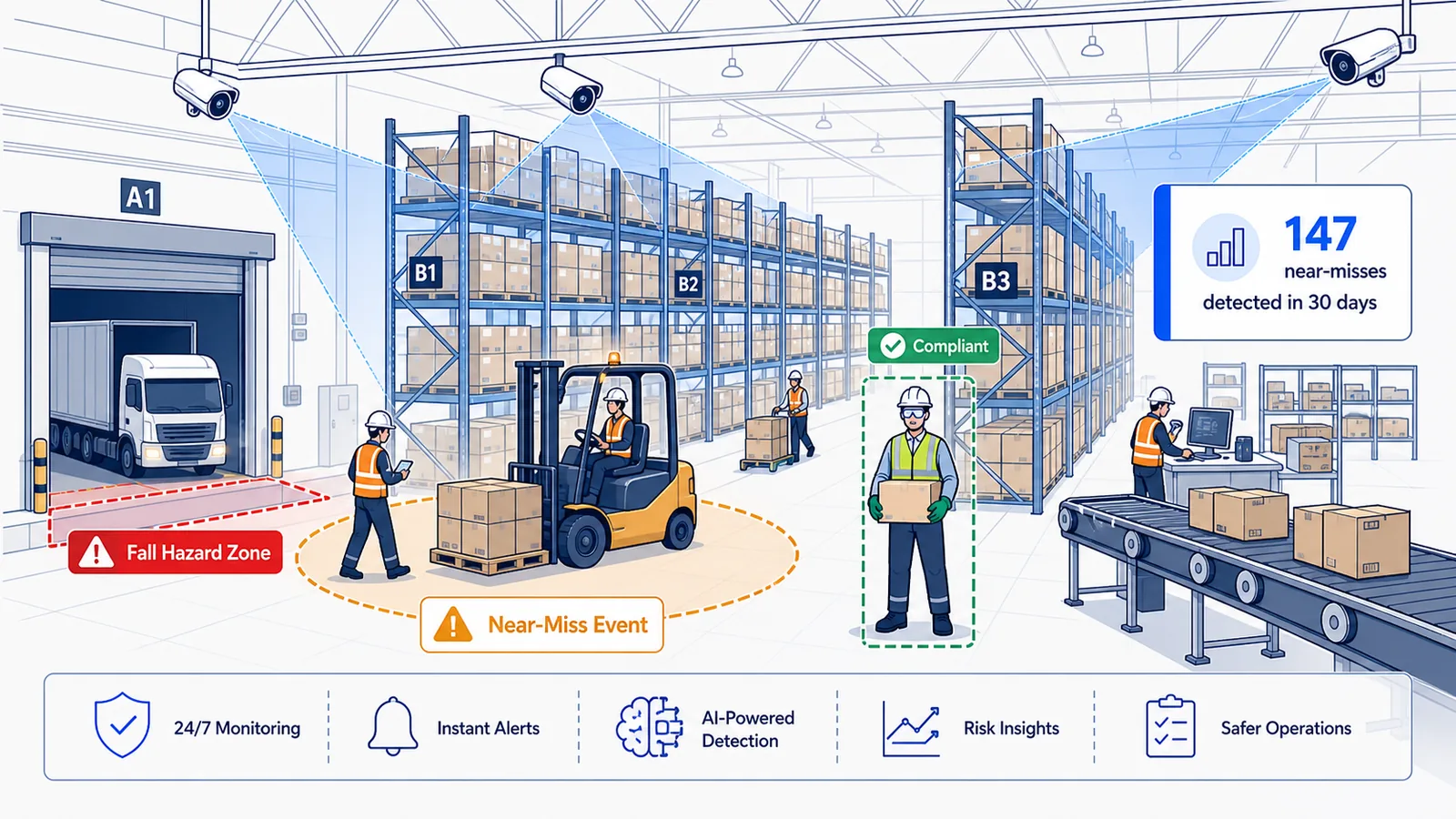
Warehouse and logistics safety AI uses computer vision and existing facility cameras to detect unsafe acts and conditions — including forklift-pedestrian near misses, PPE gaps, and dock edge hazards — in real time. As logistics facility security AI software, it extends the same camera infrastructure already used for asset and access security into a continuous safety layer that protects people, equipment, and throughput simultaneously. For high-velocity logistics operations, it provides Live Site Intelligence that reduces preventable risk events across shifts, SKUs, and seasons, and pairs naturally with adjacent capabilities like predictive safety analytics and safety compliance automation.
AI Hazard Detection for Warehouses: What It Covers
AI hazard detection for warehouses is the real-time identification of unsafe acts, unsafe conditions, and near misses across forklifts, pedestrians, docks, conveyors, and storage zones — using existing IP cameras and computer vision models calibrated to the facility’s actual layout, lighting, and traffic patterns. Coverage typically spans forklift-pedestrian proximity, PPE compliance (hi-vis, hard hat, safety footwear), dock edge violations, restricted zone breaches, conveyor intrusions, and vehicle speed or wrong-direction travel. Detections do not just generate alerts; they feed corrective actions, incident-based micro-training, and leading-indicator reports that warehouse and logistics leaders can defend to operations, finance, and underwriters.
Logistics Safety Issues: Why Traditional Methods Fall Short
The logistics industry faces a unique convergence of safety challenges that manual processes cannot keep pace with:
- Speed-safety tension: Same-day fulfillment and cross-dock throughput create constant pressure to move faster, often at the expense of safety protocols.
- High workforce turnover: Temporary and seasonal workers in 3PL operations receive minimal safety orientation, increasing exposure during their most vulnerable first weeks.
- Multi-vehicle environments: Forklifts, reach trucks, pallet jacks, and autonomous mobile robots (AMRs) share floor space with pedestrian workers in compressed aisles.
- Complex supply chain handoffs: Inbound receiving, outbound staging, and cross-dock marshaling each have distinct hazard profiles that change by the hour.
- Regulatory exposure: OSHA’s warehousing National Emphasis Program (NEP) puts logistics facilities under increased scrutiny for powered industrial truck safety, fall protection, and heat illness prevention.
These logistics safety issues compound during peak season when headcount doubles and experienced supervisors are stretched thin. AI-powered safety monitoring addresses each of these challenges by providing continuous, automated hazard detection that scales with your operation.
Introduction: The Unique Risks of Modern Warehousing
Modern warehousing runs at a pace that would have been unrecognizable a decade ago. Same-day order fulfillment, multi-SKU picking, cross-dock throughput, and last-mile pressure have turned distribution centers into precision engines where every second of downtime costs money. In this environment, safety and speed are often treated as opposing forces — and when they collide, safety usually loses.
That tension shows up in the numbers. The U.S. Bureau of Labor Statistics reports that the warehousing and storage industry recorded an incidence rate of 4.8 recordable cases per 100 full-time workers in recent years — a figure that sits well above the national average for all industries (third-party statistic). Forklifts alone account for roughly 85 fatal accidents and 34,900 serious injuries annually in U.S. workplaces, according to OSHA estimates (third-party statistic). In a facility where pickers, packers, reach truck operators, and yard jockeys share compressed aisles, the margin for error is razor-thin.
The problem is not that warehouse leaders do not care about safety. The problem is that traditional safety programs — manual inspections, clipboard audits, and incident-only reporting — were built for slower operations. They cannot keep up with the velocity of modern logistics. That is where a Safety Intelligence Platform changes the equation.
The Warehouse Safety Challenge: Forklifts, Conveyors, Loading Docks, and High Velocity
Warehouses are not monolithic environments. A typical 3PL or distribution center contains overlapping hazard zones, each with its own risk profile:
Forklift and reach truck traffic. Pedestrian-forklift interactions are the single largest source of serious incidents in warehousing. Blind corners, narrow aisles, and high-rack storage create constant proximity risks. In a facility running 200,000+ SKUs with inventory turns every 30 days, forklift movements are relentless.
Conveyors and sortation systems. Package sortation lines run at fixed speeds that do not pause for lanyards, loose clothing, or inattentive reach-ins. Lockout/tagout violations on conveyor maintenance are common and dangerous.
Loading docks. The dock is one of the most hazardous zones in any warehouse. Edge falls, trailer creep, and pedestrian-trailer interface incidents spike during peak season when dock doors operate at maximum velocity.
Cross-dock and marshaling areas. In cross-dock operations, goods move directly from inbound to outbound with minimal storage. Workers, equipment, and freight converge in open floor spaces with less predictable traffic patterns than racked aisles.
Peak season pressure. From Black Friday through post-holiday returns, headcount can double, temporary workers enter the floor with minimal orientation, and safety observation rates often drop just as risk rises.
Traditional EHS software captures what happened after the fact. It does not see the near miss between a forklift and a picker in Aisle 14. It does not flag the dock worker without a hi-vis vest during the 2:00 AM shift. It does not generate leading indicators that operations leaders can act on before the next incident.
5 AI Safety Applications for Warehousing
A warehouse safety AI deployment targets the specific hazard patterns of logistics operations. Here are five high-impact applications that distribution centers and 3PLs deploy first:
1. Forklift-Pedestrian Proximity Detection
Computer vision models monitor aisle intersections, pick modules, and travel paths to detect when a forklift and pedestrian enter a predefined proximity zone. The system generates real-time alerts to the operator and control room, turning near misses into coached moments instead of incident reports. In pilot benchmarks, facilities have seen a measurable reduction in close-call events within the first 30 days of deployment (pilot benchmark).
Forklift Collision Avoidance Systems
A forklift collision avoidance system uses AI-powered sensors and computer vision to prevent accidents between forklifts and pedestrians before they happen. Unlike traditional proximity sensors that only beep, AI collision avoidance identifies the type of hazard — pedestrian, other vehicle, or structural obstacle — and delivers context-aware alerts to operators through dashboard displays or wearable devices.
How it works:
- Cameras mounted at aisle intersections and travel paths feed live video to AI models trained on warehouse environments
- The system calculates collision risk based on speed, direction, and proximity
- When risk exceeds a threshold, alerts fire to both the forklift operator and floor supervisor
- Events are logged with video evidence for coaching and compliance documentation
Forklift collision avoidance differs from basic proximity sensors in three ways: it sees around corners, it distinguishes between pedestrians and inanimate objects, and it learns your facility's traffic patterns to reduce false alarms over time.
Forklift Warning Systems
Forklift warning systems provide layered alerts that escalate with risk level. A pedestrian entering a shared aisle 15 meters away triggers a yellow advisory. At 5 meters, the alert turns red with an audible tone. If the pedestrian steps into a designated danger zone, the system can trigger automatic speed reduction through integration with the forklift's telematics system.
The most effective forklift warning systems combine visual alerts (LED displays), audio alerts (directional speakers), and haptic feedback (vibrating wearables) so operators receive warnings regardless of cabin noise or visual obstructions.
2. PPE Compliance at Speed
Hi-vis vests, hard hats, and safety shoes are mandatory in most warehouse zones — but enforcing compliance across hundreds of workers across three shifts is nearly impossible with floor walks alone. AI warehouse monitoring checks PPE status at entry points, aisle transitions, and high-risk zones without stopping foot traffic or interfering with picking productivity.
3. Loading Dock Edge Monitoring
The dock edge is a leading location for falls and crush incidents. Vision-based detection monitors for workers operating too close to open dock doors, missing dock plates, or trailer separation gaps. Alerts fire before a foot crosses the threshold, not after a fall occurs.
4. Conveyor and Sortation Safety
AI monitors for unauthorized entry into guarded conveyor zones, lockout/tagout breaches during maintenance windows, and body-part proximity to active sortation equipment. These detections feed directly into safety compliance automation workflows that assign corrective actions to supervisors with timestamps and photographic evidence.
5. Restricted Zone and Cross-Dock Breach Alerts
High-value inventory zones, battery charging stations, and cross-dock staging areas require controlled access. AI safety systems detect unauthorized entries, wrong-direction travel, and after-hours presence — all without installing physical gates that slow material flow.
Ready to see how warehouse safety AI fits your operation? Explore our warehousing and logistics safety solutions or learn how AI hazard detection works with your existing cameras.
Real-Time Monitoring in 24/7 Operations
Logistics does not sleep. A facility supporting e-commerce or food distribution may run two to three shifts with skeleton crews on weekends. Supervisors cannot be everywhere at once — and safety incidents do not wait for the day shift.
A logistics safety AI platform provides continuous coverage across all shifts without adding headcount. AURA (Autonomous Unified Recognition & Action) Engine — an adaptive safety intelligence platform — runs the same detection models at 2:00 AM on a Sunday as it does at 2:00 PM on a Tuesday. That consistency matters because incident data often reveals that second and third shifts carry disproportionate risk (anonymized deployment).
During peak season, when temporary workers flood the floor and overtime extends into weekends, real-time monitoring acts as a force multiplier. Supervisors receive prioritized alert feeds instead of manually scanning dozens of camera feeds. The system flags the highest-risk events — a forklift speeding through a pedestrian zone, a group of pickers without hi-vis in a cross-dock area — so human attention goes where it matters most.
Integration with WMS and Existing Infrastructure
The fastest way to kill a warehouse safety initiative is to ask operations to rip out cameras, re-cable the network, or integrate with a WMS that took three years to stabilize. Distribution center IT teams are rightfully protective of uptime.
SAFVR's approach is designed for zero operational disruption. The platform connects to existing IP cameras — the same cameras already used for security, inventory verification, or loss prevention — and processes video streams through edge or cloud inference. There is no requirement for proprietary hardware, no camera replacement, and no interference with warehouse management systems, order management platforms, or TMS integrations.
For facilities with hybrid environments — some legacy analog cameras alongside newer IP units — the deployment plan maps coverage gaps and recommends minimal, targeted upgrades only where necessary. The goal is to get to full floor coverage quickly without touching a single conveyor or picking workflow.
Measuring Warehouse Safety Impact
Logistics leaders are metrics-driven. A warehouse safety AI platform must speak the language of the operation — incidents per unit, compliance rates by zone, and closure velocity on corrective actions. Here are the KPIs that matter most in distribution and 3PL environments:
| KPI | What It Measures | Why It Matters for Logistics |
|---|---|---|
| Near-miss detection rate | Number of proximity and hazard events flagged per shift | Leading indicator that predicts serious incidents before they happen |
| PPE compliance rate by zone | Percentage of workers in proper gear in defined areas | Protects against liability and shows coaching opportunities |
| Time to alert | Seconds from event detection to supervisor notification | Faster response = faster intervention = less severity |
| Incidents per million units shipped | Safety performance normalized to throughput | Allows comparison across facilities with different volume profiles |
| Safety observation closure rate | Percentage of flagged items resolved with documented action | Closes the loop between detection and correction |
| Underwriter-ready leading indicator reports | Trend data on near misses, compliance, and risk patterns | Supports insurance renewals and risk financing discussions |
These metrics are not abstract safety scores. They are operational data points that warehouse managers and logistics directors can use in daily standups, quarterly business reviews, and carrier compliance audits. The platform generates Site-Specific Safety Intelligence — not generic benchmarks — so a cross-dock facility in Memphis and a cold-storage warehouse in Phoenix each see metrics calibrated to their actual conditions.
The Warehouse Pilot: 30 Days to Safer Operations
A 30-day pilot is the standard entry point for warehouse safety AI. The timeline is designed to prove value without requiring a long procurement cycle or operational disruption:
Week 1: Site assessment and camera mapping. The SAFVR team maps existing camera coverage against hazard zones — docks, aisles, conveyor lines, and entry points. Most facilities have 60–80% of required coverage already in place from security infrastructure (illustrative example).
Week 2: Model calibration and zone configuration. Detection models are calibrated to the facility's specific layout, lighting conditions, and traffic patterns. Zone rules are configured — for example, defining pedestrian-only walkways versus shared forklift-pedestrian aisles.
Week 3: Live detection and alert validation. The system goes live with real-time detection. Operations and safety teams validate alert accuracy, tune sensitivity thresholds, and integrate alert routing into existing supervisor workflows.
Week 4: Reporting and impact review. The first batch of leading-indicator data is compiled — near-miss trends, PPE compliance baselines, and zone-level risk heat maps. This data becomes the foundation for a full-site rollout decision.
The 30-day safety intelligence pilot is free and requires no upfront hardware investment.
Start your warehouse safety AI pilot today. Schedule a 30-day pilot to see Live Site Intelligence in your facility, or explore the full Safety Intelligence Platform to learn how DETECT, ACT, IMPROVE, and PREVENT work together.
Frequently Asked Questions
What is warehouse safety AI and how does it differ from traditional EHS software?
Warehouse safety AI is a computer vision-based system that uses existing facility cameras to detect unsafe acts and conditions in real time. Traditional EHS software relies on manual incident reporting, inspections, and lagging indicators. A Safety Intelligence Platform provides leading indicators — near misses, PPE gaps, and proximity events — as they happen, not after the shift ends.
What are the most common logistics safety issues?
The top safety issues in logistics and warehouse operations include forklift-pedestrian collisions, dock edge falls, conveyor entanglement, PPE non-compliance, heat stress during peak season, and ergonomic injuries from repetitive lifting. AI safety monitoring addresses these by detecting unsafe conditions in real time before they become incidents.
Can warehouse safety AI work with our existing camera infrastructure?
Yes. SAFVR is designed to work with existing IP cameras without rip-and-replace. In most warehouses, the security camera network already covers the primary hazard zones — docks, aisles, and conveyors. The platform connects to these streams and adds AI inference without interfering with WMS, TMS, or order management systems.
How does AI monitoring handle peak season and high-SKU environments?
Peak season increases both headcount and hazard exposure. AI warehouse monitoring scales automatically because it does not depend on supervisor headcount or floor-walk frequency. The system detects the same hazards — forklift proximity, PPE violations, dock edge risks — whether the floor has 50 workers or 500. Temporary workers receive the same real-time protection as tenured staff.
What types of warehouse hazards can computer vision detect?
Current capabilities include forklift-pedestrian proximity, PPE non-compliance (hi-vis, hard hats, safety footwear), loading dock edge violations, restricted zone breaches, conveyor zone intrusions, and speeding or wrong-direction vehicle travel. The detection suite expands based on site-specific risk profiles.
How quickly can a warehouse safety AI platform deliver measurable results?
Most facilities see initial detection data and baseline metrics within the first 7–10 days of a pilot. By Day 30, operations teams typically have enough near-miss and compliance data to identify their highest-risk zones, shifts, and behavior patterns. Incident reduction trends become visible over 60–90 days as coaching and workflow improvements take hold (pilot benchmark).
Conclusion: Safety at the Speed of Logistics
Warehousing does not slow down. Neither should safety.
A warehouse safety AI deployment gives logistics leaders the same real-time visibility into risk that they already have into inventory, orders, and throughput. It turns every camera into a safety sensor. It turns every detection into an accountable action. And it turns months of lagging incident data into immediate, site-specific intelligence that protects workers without slowing the operation.
If your facility runs forklifts 18 hours a day, processes millions of SKUs annually, or faces peak-season staffing surges, manual safety programs are no longer enough. You need Live Site Intelligence that matches the velocity of your business.
Start your paid 30-day warehouse safety pilot →
Related Reading
- Manufacturing Safety AI Guide — Compare warehouse and manufacturing safety challenges and how AI adapts to fixed-line production environments.
- PPE Detection AI: The Complete Guide — How computer vision enforces PPE compliance in high-traffic zones like loading docks and conveyor lines.
- Near-Miss Trend Analysis Guide — Turn forklift-pedestrian near misses and dock incidents into actionable prevention data.