Last updated: 2026-04-25
Construction safety AI uses computer vision and existing site cameras to detect PPE violations, fall hazards, exclusion zone breaches, and heavy equipment proximity risks in real time. Unlike static facility safety systems, it adapts as job sites evolve — recalibrating detection zones when scaffolding moves, cranes relocate, and new subcontractors arrive.
Introduction: Why Construction Is Different
Construction sites are not factories. A manufacturing plant has fixed lines, permanent camera mounts, and a stable workforce. Construction has mobilization and demobilization. Swing stages move weekly. Laydown yards shift as materials arrive. And the workforce changes with every phase of the build.
You cannot post a permanent guard at every evolving hazard. You cannot run effective toolbox talks when half the crew is new this week. And you cannot rely on static camera positions when the structure itself changes shape every month.
Construction accounted for 20.3% of all private-industry worker fatalities in the United States in 2023 — the highest of any sector (third-party statistic, Bureau of Labor Statistics). The leading causes — falls, struck-by incidents, and caught-in/between events — are all visually detectable. For GCs and site superintendents, construction safety AI is becoming essential infrastructure.
Why Construction Sites Need AI Safety
Construction safety managers face three realities that static facilities rarely encounter:
High Mobility: The Site Changes Daily
Yesterday's pour crew is today's framing crew. The crane that lifted steel last week is being relocated to the east pad this morning. Exclusion zones around excavation change as backfill progresses. A safety system that cannot adapt creates blind spots exactly where new hazards emerge.
AI hazard detection designed for construction recalibrates as the site evolves. When cameras move to monitor a new phase, detection zones remap automatically. When a tower crane shifts position, the swing radius exclusion zone updates without a technician visit.
Changing Environments: Every Phase Has Different Risks
Foundation work brings trench hazards and heavy equipment proximity risks. Structural steel introduces working-at-height exposures and struck-by hazards from overhead loads. Interior fit-out changes the risk profile to electrical work, confined spaces, and material handling in tight quarters.
A general contractor running multiple phases simultaneously needs a unified view across all of them — not separate systems for each stage. Construction safety AI provides that single pane of glass, with phase-specific detection rules that activate as work progresses.
Subcontractor Complexity: Multiple Cultures, One Site
On a typical commercial build, the GC manages a dozen or more subcontractors — each with their own safety culture, training standards, and compliance awareness. Some subs run tight ships. Others bring workers who have never set foot on this site before and may not understand the specific hazards in Zone B.
Traditional approaches rely on manual orientations and paper sign-in sheets. By afternoon, the site superintendent has no visibility into which sub is working where, let alone whether they are following site-specific protocols. AI construction safety provides continuous, objective visibility across every crew — regardless of which subcontractor badge they wear.
Running a multi-sub job site? See how SAFVR's AURA engine adapts to construction's unique challenges on the construction industry page, or start a 30-day safety intelligence pilot calibrated to your current build phase.
6 AI Safety Use Cases for Construction
Vision AI for construction addresses the hazards that drive the majority of recordable incidents:
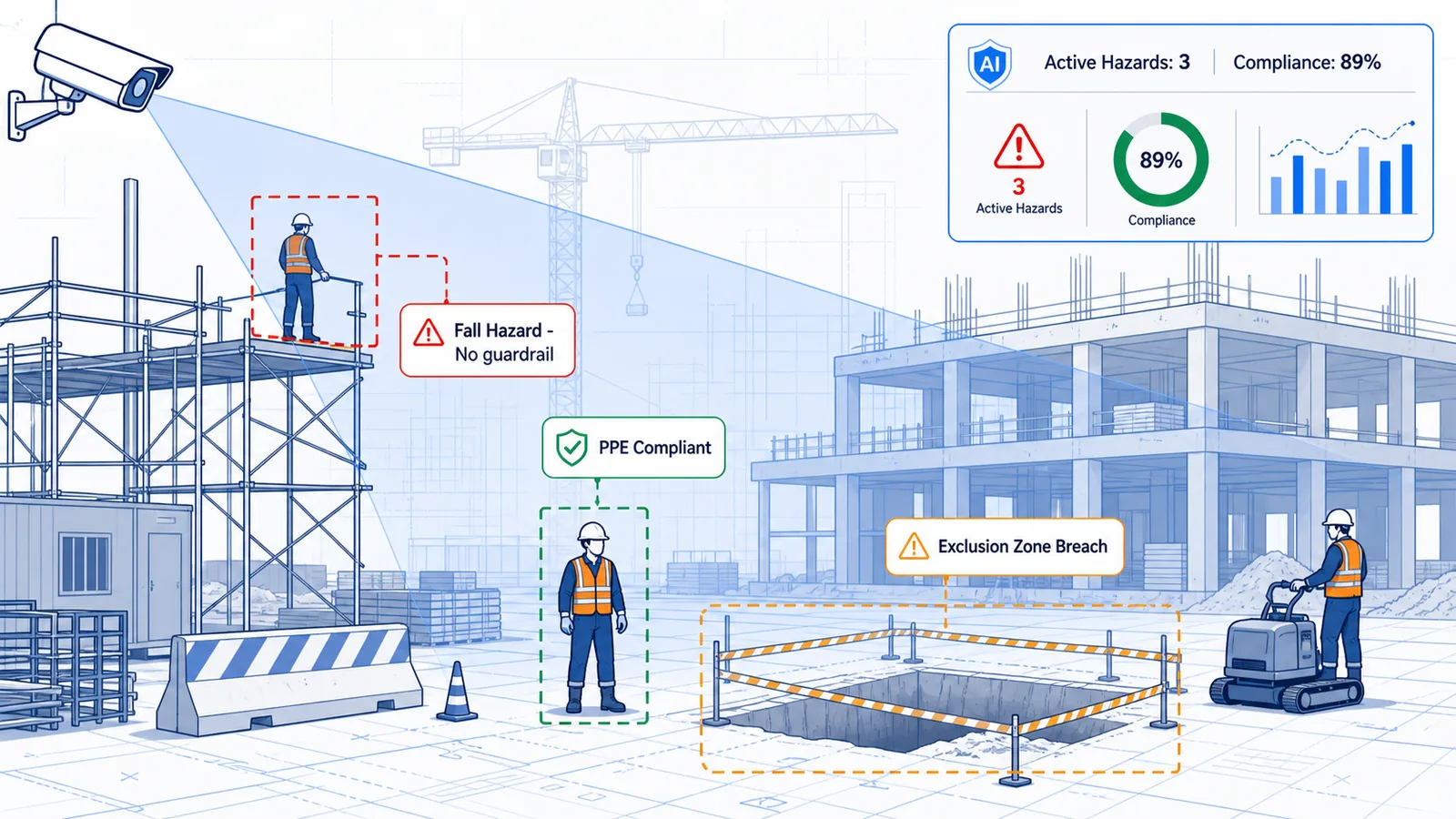
1. Fall Protection and Working-at-Height Detection. Falls remain the leading cause of construction fatalities. AI monitors guardrail integrity, harness compliance on scaffolding and swing stages, and proper use of personal fall arrest systems. When a worker approaches an unprotected edge, the system alerts the site safety manager within seconds.
2. Construction PPE Detection. Hard hats, high-visibility vests, safety glasses, and steel-toe boots are baseline requirements on every commercial job site. AI verifies compliance at entry gates, active work zones, and laydown yards — catching violations that occur after workers pass the initial checkpoint.
3. Exclusion Zone Enforcement. Crane swing radii, excavation perimeters, and heavy equipment operating zones require strict boundaries. AI draws virtual perimeters and triggers alerts when workers or vehicles breach them. As equipment relocates, zones remap without hardware changes.
4. Heavy Equipment and Pedestrian Proximity. Struck-by incidents involving heavy equipment are a top cause of serious injuries. AI identifies when a pedestrian enters a vehicle's path and alerts both the operator and the site supervisor.
5. Scaffold and Access Point Monitoring. Improper scaffold access, missing mid-rails, and overloaded platforms create daily exposure. AI monitors scaffold gates, access ladders, and platform occupancy — flagging violations that manual walkthroughs often miss.
6. Permit-to-Work Zone Verification. Hot work, confined space entry, and live electrical work require permitted, controlled zones. AI verifies authorized personnel entry, confirms required PPE, and monitors for unauthorized access during active permits.
| Use Case | Hazard Addressed | Key Benefit |
|---|---|---|
| Fall protection | Falls from height | Immediate alert before a fall occurs |
| PPE compliance | Head, eye, body injuries | Continuous monitoring across all zones |
| Exclusion zones | Struck-by, caught-in | Auto-remaps as site layout changes |
| Equipment proximity | Struck-by vehicles | Alerts both operator and pedestrian |
| Scaffold monitoring | Falls, collapses | Catches violations manual inspection misses |
| Permit zones | Fire, electrocution, entrapment | Real-time permit compliance verification |
Portable vs Fixed Deployment: How AI Adapts to Changing Job Sites
The most common objection from construction safety managers is: "Our cameras move every few weeks. How can AI work if the view keeps changing?"
This is where building safety AI diverges from fixed-facility solutions:
Temporary Camera Infrastructure. Construction deployments use temporary camera poles, trailer-mounted units, and existing site security cameras. AURA's detection engine calibrates to new positions within hours, not days. When a camera relocates, the safety team updates the feed mapping — and detection resumes for the new zone (pilot benchmark).
Phase-Based Detection Profiles. Each construction phase has distinct hazards. AURA stores phase-specific detection profiles that activate as the build progresses. Foundation-phase profiles emphasize trench and equipment hazards. Structural-phase profiles prioritize working-at-height and crane exclusion zones. Fit-out profiles focus on electrical and confined space risks.
Edge Processing for Connectivity-Challenged Sites. Portable edge processors run detection locally, syncing data when the connection returns. A remote site or basement level with weak signal still gets real-time alerts on-site.
Mobilization-to-Handoff Timeline. From camera placement to live detection, a typical construction pilot deploys in 3 to 5 days (pilot benchmark). When the project hands off to the owner, detection profiles and incident histories transfer cleanly for facilities management use.
Managing Subcontractor Safety Compliance
Subcontractor safety is where most GCs lose sleep. You are responsible for site safety, but you do not directly employ half the people on-site. Paper orientations do not tell you whether Subcontractor C's crew is following your protocols in Zone A this afternoon.
AI construction safety provides objective, continuous visibility. Every detection links to a time and zone — giving safety managers crew-level compliance trends and highlighting where patterns suggest a training gap rather than an isolated mistake.
When AURA detects a recurring issue — say, workers from a particular subcontractor consistently missing hard hats in the laydown yard — it generates a targeted micro-training module using actual footage from that site, delivered in the worker's language (anonymized deployment).
Instead of compiling separate safety reports from each subcontractor, the GC gets a single dashboard showing compliance trends across every crew — real-time situational awareness that paper logs cannot match.
Measuring Construction Safety Impact
Construction safety AI delivers measurable improvements in the metrics that matter to GCs, owners, and underwriters:
| Metric | Before AI Safety | After AI Safety (Typical Range) | Measurement Basis |
|---|---|---|---|
| Total Recordable Incident Rate (TRIR) | Baseline | 30–60% reduction in targeted categories within 6 months | Pilot benchmark |
| Experience Modification Rate (EMR) | Annual lagging indicator | Trend improvement visible in next rating cycle | Anonymized deployment |
| Lost-Time Incident Rate | Baseline | 25–45% reduction in visually detectable events | Pilot benchmark |
| Near-Miss Detection Rate | Low — workers rarely self-report | 3–5x increase in detected near-misses | Pilot benchmark |
| PPE Compliance Rate | 70–85% (spot-check basis) | 92–98% (continuous monitoring) | Anonymized deployment |
| Safety Manager Admin Time | 15–20 hrs/week on manual follow-up | 5–8 hrs/week after workflow automation | Illustrative example |
| Subcontractor Violation Close-Out | 2–5 days (paper-based) | Same-day to 24 hours (automated) | Pilot benchmark |
These metrics matter beyond the site. A lower TRIR and improving EMR affect bid competitiveness on public projects where safety performance is scored. Underwriter-ready leading indicator reports give CFOs and risk managers proactive evidence for premium discussions (anonymized deployment).
Want structured safety reports from your next build? Start a 30-day safety intelligence pilot and generate leading-indicator data your risk team can use.
The Construction Pilot: From Mobilization to Results
Deploying construction safety AI is not a multi-month IT project. A well-run pilot follows a clear phase structure:
| Phase | Duration | Activities | Outcome |
|---|---|---|---|
| Mobilization | Days 1–2 | Site walk, camera positioning plan, hazard zone mapping, subcontractor crew list import | Deployment plan aligned to current build phase |
| Setup & Calibration | Days 3–5 | Camera feed connection, detection zone configuration, alert routing, PPE baseline calibration | Live detection operational |
| Monitoring & Tuning | Weeks 2–4 | Daily alert review, false-positive tuning, phase-specific profile refinement, compliance baselining | Calibrated detection with <5% false-positive rate |
| Workflow Automation | Weeks 3–4 | Automated alert escalation, micro-training triggers, permit-to-work integration, dashboard activation | Closed-loop safety system running |
| Results & Handoff | Week 4+ | Trend reporting, TRIR/EMR baseline documentation, underwriter report generation, expansion planning | Pilot results and full-deployment roadmap |
The key to success is starting with the current phase's highest-risk zones — not covering the entire site on day one. Most pilots begin with fall protection and PPE detection at the most active work face, then expand as the safety team gains confidence (pilot benchmark).
Because AURA works with existing camera infrastructure, there is no rip-and-replace. Site security cameras, temporary tower cams, and subcontractor-owned feeds integrate into the same detection layer. When the project moves to the next phase, the model moves with it.
Frequently Asked Questions
How does construction safety AI handle cameras that move as the build progresses?
Construction safety AI is designed for mobility. Detection zones recalibrate when cameras relocate, and phase-specific profiles activate as work moves from foundation to structure to fit-out. Temporary camera poles, trailer-mounted units, and existing security cameras all integrate. Setup for a relocated camera typically takes hours, not days (pilot benchmark).
Can AI construction safety distinguish between different subcontractors on-site?
Yes. Where cameras and access control support it, detection events link to time, zone, and crew identity. Safety managers view compliance trends by subcontractor, identify which crews need targeted training, and generate unified reports for the GC. Even without identity linkage, zone-based grouping provides crew-level visibility.
What construction hazards can AI detect that manual inspections miss?
AI detects visually identifiable hazards continuously — not just during scheduled walkthroughs. This includes unguarded edges, missing fall protection, PPE violations in remote zones, exclusion zone breaches after hours, and pedestrian-equipment proximity events. Continuous monitoring catches the events that happen between inspections.
How does construction PPE detection work in low light or adverse weather?
Modern vision AI models trained on construction environments perform reliably in low light, dust, and typical weather. Infrared-capable cameras extend detection to night shifts. Edge processing ensures alerts work even when cloud connectivity is intermittent — critical for remote sites or basement levels with weak signal.
Is construction safety AI designed to support OSHA compliance?
Construction safety AI is designed to support compliance workflows by documenting PPE enforcement, exclusion zone adherence, permit-to-work verification, and incident evidence with timestamped video. It automates the record-keeping and audit trail generation that OSHA recordkeeping requires. However, no AI system guarantees compliance outcomes — it provides the evidence and automation that safety teams need to manage compliance effectively.
Conclusion
Construction sites are the most dynamic workplaces in industry. Scaffolding moves. Cranes relocate. Subcontractors rotate. Hazards emerge and disappear within a single phase. Static safety plans and periodic inspections cannot keep pace with this reality.
Construction safety AI was built for exactly this environment. It detects PPE violations, fall hazards, exclusion zone breaches, and equipment proximity risks using the cameras you already have — no rip-and-replace required. It recalibrates as your site evolves. It gives GCs and site superintendents unified visibility across every subcontractor crew. And it produces the leading-indicator reports that underwriters and owners expect.
If you are managing a commercial build and tired of discovering safety gaps after the fact, explore how SAFVR's AURA engine adapts to construction's realities on the construction industry page, review the AI hazard detection capabilities that power real-time site monitoring, or start your 30-day safety intelligence pilot and see results before your next phase mobilizes.
Related Reading
- PPE Detection AI: The Complete Guide — Deep dive into how computer vision enforces hard hat, vest, and glove compliance across dynamic job sites.
- Manufacturing Safety AI Guide — Compare how AI safety monitoring adapts from construction's open-air variability to manufacturing's fixed-line environments.
- AI Hazard Detection with Existing Cameras — Learn how to deploy hazard detection without rip-and-replace hardware upgrades.