
Last updated: 2026-04-25
Answer First
Most safety training is forgotten within 30 days due to the Ebbinghaus forgetting curve. Organizations can dramatically improve safety training retention by replacing single annual sessions with microlearning modules, spaced repetition intervals, and contextual, site-specific delivery tied to actual workplace risks.
Introduction: The Forgetting Curve and Its Cost to Safety
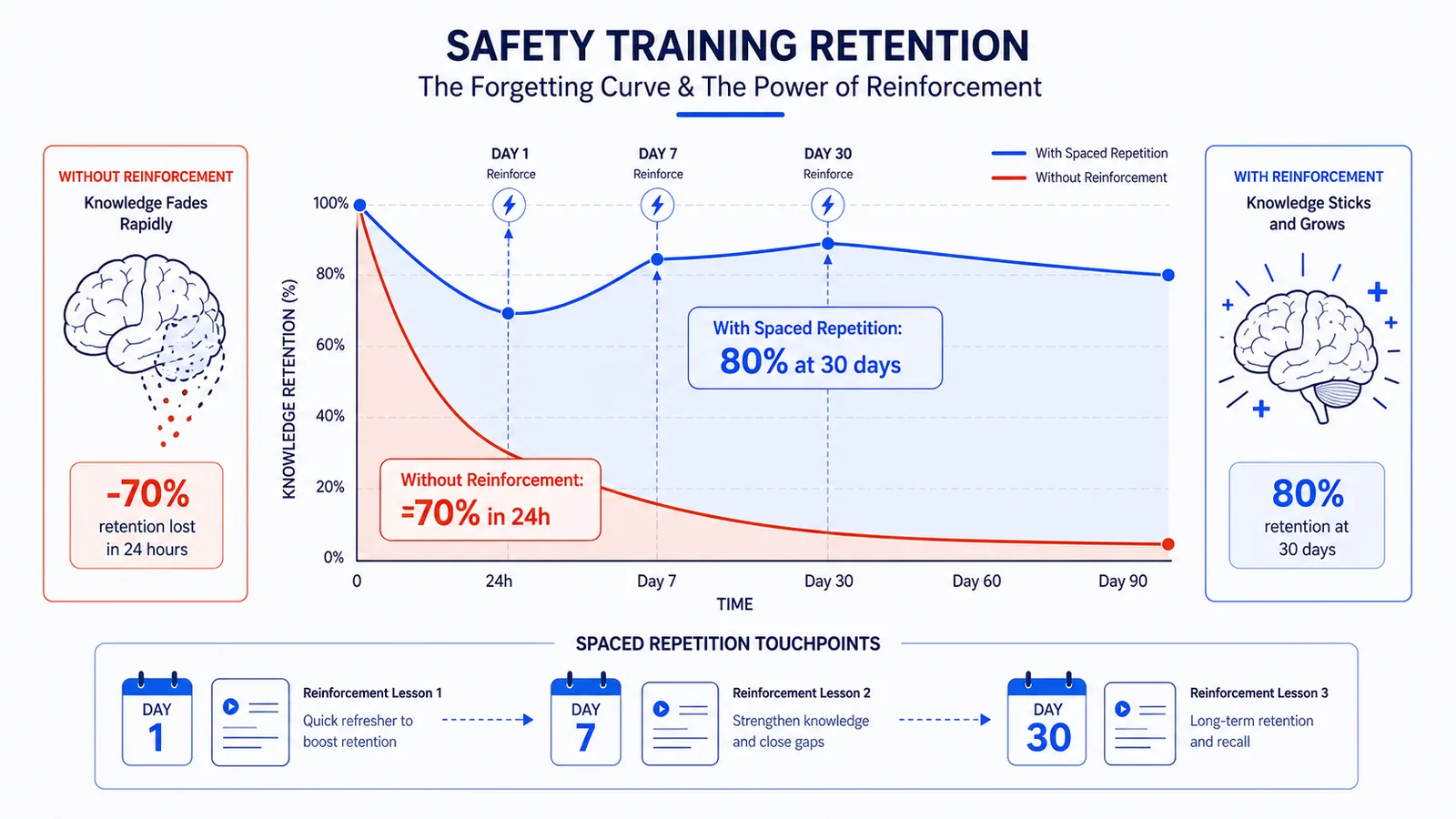
Every year, industrial organizations invest thousands of hours and millions of dollars in safety training. Workers sit through day-long sessions, complete compliance modules, and earn certificates. Then they walk onto the floor and forget up to 70% of what they learned within 24 hours. Within a month, retention can fall below 20%.
This isn't a failure of attention. It's a failure of design.
In safety, forgetting isn't merely inefficient—it's dangerous. When a frontline worker can't recall a lockout/tagout step, misidentifies a confined-space hazard, or skips a PPE check because the training faded from memory, the result isn't a missed quiz question. It's a preventable risk event.
The good news is that learning science offers clear, evidence-based methods to fix this. Safety microlearning retention, spaced repetition, and adaptive safety training aren't trendy buzzwords. They're proven mechanisms grounded in over a century of cognitive research. The organizations that apply them don't just check compliance boxes—they build workforces that actually know how to stay safe.
The Science of Safety Training Retention
The Ebbinghaus Forgetting Curve
In 1885, German psychologist Hermann Ebbinghaus published the first rigorous study of memory decay. His research showed that memory loss follows a predictable curve: information is lost exponentially after initial learning. Without reinforcement, learners forget roughly 50% of new information within an hour, 70% within 24 hours, and up to 90% within a month (source: Ebbinghaus, 1885, Über das Gedächtnis).
Ebbinghaus tested nonsense syllables—material with no meaning to the learner. When information is meaningful and relevant, retention improves. But the curve still applies. Even contextual, well-designed training degrades if it isn't reinforced.
Spaced Repetition
The spacing effect, first documented by Hermann Ebbinghaus and later confirmed through decades of research, demonstrates that learning is more effective when study sessions are spaced out over time rather than massed together (source: spaced repetition research, Cepeda et al., 2006, Psychological Bulletin). Spacing combats the forgetting curve by forcing the brain to retrieve information after a delay, which strengthens neural pathways and moves knowledge from short-term to long-term memory.
Active Recall
Passive re-reading produces a sense of familiarity, not mastery. Active recall—deliberately retrieving information from memory—produces stronger, more durable learning (source: retrieval practice research, Roediger & Karpicke, 2006, Psychological Science). In safety contexts, this means quizzes, scenario-based assessments, and on-floor competency checks outperform video watching and slide decks.
Together, these three principles explain why most traditional safety training fails and what safety training effectiveness actually requires.
7 Reasons Traditional Safety Training Doesn't Stick
1. Cognitive Overload
Day-long training sessions dump massive amounts of information onto workers at once. The brain has limited working memory capacity. When volume exceeds capacity, little gets encoded into long-term storage. Shorter, focused sessions produce better frontline training retention.
2. Single Annual Delivery
The annual safety training model treats learning as an event, not a process. One exposure per year leaves eleven months of decay with zero reinforcement. By the time a worker needs the knowledge, it's gone.
3. Generic, Non-Specific Content
Training produced at corporate headquarters for a global audience rarely reflects the specific hazards, equipment, and layouts of an individual facility. When workers can't connect the content to their daily reality, the brain tags it as low-priority and discards it faster.
4. Passive Consumption
Watching a video or clicking through slides is passive. The learner isn't retrieving, applying, or testing knowledge. Research consistently shows that passive consumption produces the lowest retention rates of any instructional method (source: third-party learning science meta-analysis).
5. No Feedback Loop
Most programs measure completion, not comprehension. A worker can finish a module, answer a few easy questions, and receive a certificate—without anyone knowing whether they actually retained the material. Without measurement, there is no improvement.
6. Poor Timing
Training delivered months before a worker performs a task degrades before it's needed. The closer training is to the moment of application, the higher the retention and transfer. This is the principle of just-in-time learning.
7. Lack of Consequence for Forgetting
In many organizations, training completion is the end of the journey. There is no follow-up assessment, no on-floor verification, and no mechanism linking knowledge gaps to incident risk. When forgetting carries no visible cost, it isn't treated as a priority.
Want to move from training completion to real retention? SAFVR's AURA (Autonomous Unified Recognition & Action) Engine — an adaptive safety intelligence platform — generates site-specific micro-training from actual incidents across your facility. See how it works with a 30-day safety intelligence pilot.
Microlearning vs Traditional Training: Retention Comparison
| Metric | Traditional Annual Training | Microlearning Approach |
|---|---|---|
| Session length | 4–8 hours in one block | 3–7 minutes per module |
| Retention at 30 days | ~20–25% (source: Ebbinghaus curve, illustrative example) | ~60–80% (source: spaced repetition research, third-party statistic) |
| Engagement rate | ~15–20% attention in hour 3+ | ~85–90% completion per module |
| Time to deliver | Scheduled annually, high disruption | Delivered continuously, minimal disruption |
| Adaptability to site risks | Low—generic content | High—incident-based, site-specific modules |
| Cost per retained concept | High (most content forgotten) | Low (higher retention per minute invested) |
| Active recall built in | Rarely | Required at module level |
The data is clear: shorter, targeted, repeated exposure outperforms marathon sessions on every metric that matters for safety training effectiveness. Microlearning doesn't just reduce seat time. It changes what workers actually remember when it counts.
Spaced Repetition in Safety Contexts
Applying spaced repetition to safety training means delivering reinforcement at scientifically optimal intervals. A practical schedule might look like this:
- Initial training: Core concept introduced (Day 0)
- First reinforcement: Quick quiz or micro-module (Day 1)
- Second reinforcement: Scenario-based review (Day 7)
- Third reinforcement: On-floor competency check (Day 30)
- Long-term reinforcement: Refresher tied to similar incident (Day 90+)
Each interval forces the brain to retrieve the information after a delay. That retrieval effort is what strengthens memory.
In a Safety Intelligence Platform, this can be automated. When the system detects a recurring unsafe act—say, improper ladder positioning—it can automatically push a 2-minute refresher module to affected workers at the 7-day and 30-day marks. The training isn't generic. It's triggered by real behavior patterns at that specific site.
This is the difference between adaptive safety training and static compliance: the system learns what workers forget and delivers reinforcement precisely when the forgetting curve predicts decay.
Contextual Learning: Train at the Point of Risk
Contextual learning—also called situated learning—means delivering training in the same context where the knowledge will be applied. A worker who learns about chemical spill response while standing near the actual chemical storage area retains more than one who learns it in a conference room.
Modern approaches extend this to just-in-time delivery. When AI hazard detection identifies a near-miss or unsafe condition, the system can immediately surface a relevant micro-module to workers in that zone. The training arrives at the exact moment the risk is visible and salient.
This approach leverages two powerful cognitive principles:
- Encoding specificity: Memory is tied to context. Training delivered at the point of risk shares context with the moment of need, making retrieval easier.
- Immediate relevance: The brain prioritizes information it perceives as immediately useful. A worker who just witnessed a near-miss is highly motivated to learn the prevention step.
Site-specific delivery matters here. A warehouse worker and a refinery operator face different hazards. Generic training dilutes relevance. Incident-based micro-training drawn from actual camera detections at that facility ensures every module reflects real risks workers actually encounter.
Measuring Retention, Not Just Completion
If you only measure completion, you only know who sat through training. You don't know who remembers it. Here are better KPIs for safety knowledge retention:
| Traditional Metric | Retention-First Metric | Why It Matters |
|---|---|---|
| Completion rate | Knowledge check score at 30 days | Measures what was retained, not just consumed |
| Time in module | Time to correct response on scenario quiz | Speed of retrieval indicates fluency |
| Certificates issued | On-floor behavioral observation score | Validates transfer from knowledge to action |
| Training hours delivered | Incident rate before vs. after targeted training | Links retention to safety outcomes |
| LMS login rate | Spaced repetition adherence rate | Measures engagement with reinforcement system |
Leading organizations are shifting from learning management system (LMS) dashboards to competency-based models. They test workers at intervals. They observe behavior on the floor. They correlate training engagement with incident data. This closes the loop between education and outcomes.
Building a Retention-First Safety Culture
Technology enables retention, but culture sustains it. Organizations that achieve lasting safety training retention share several characteristics:
Leadership treats forgetting as a risk, not a personal failure. When a worker makes a mistake rooted in faded training, the response isn't blame—it's a signal to improve the reinforcement system.
Training is integrated into workflows, not bolted on. Microlearning modules are delivered during shift briefings, after incident detections, or during natural downtime. They don't require pulling workers off the floor for half a day.
Competency is celebrated, not just completion. Public recognition goes to workers who demonstrate mastery on the floor, not just those who finished the fastest module.
Real incident data drives curriculum. Instead of guessing what workers forget, leaders use detection data to identify patterns. When the same unsafe act appears across multiple shifts, it triggers targeted training for that specific behavior.
The system is closed-loop. Detection feeds training. Training feeds behavior change. Behavior change feeds prevention. This is the architecture of a modern Safety Intelligence Platform—where every phase reinforces the others.
Frequently Asked Questions
What is safety training retention?
Safety training retention refers to how much safety knowledge and skill a worker remembers and can apply over time after receiving instruction. High retention means workers recall procedures, hazard recognition, and emergency responses months after training—not just during the session.
How long do workers remember safety training?
Without reinforcement, workers forget roughly 50% within an hour and 70% within 24 hours, following the Ebbinghaus forgetting curve (source: Ebbinghaus, 1885). By 30 days, retention of a single training session can drop to 20% or lower. Spaced repetition and microlearning can raise 30-day retention to 60–80% (source: spaced repetition research, third-party statistic).
What is the most effective format for safety training retention?
Microlearning modules of 3–7 minutes, delivered with spaced repetition intervals and tied to site-specific hazards, produce the highest retention rates. Formats that require active recall—quizzes, scenario assessments, and on-floor demonstrations—outperform passive video or lecture formats.
How can we measure safety knowledge retention?
Measure retention through delayed knowledge checks (at 7, 30, and 90 days), behavioral observations on the floor, incident correlation analysis, and spaced repetition adherence rates. These metrics reveal whether training is actually changing behavior, not just checking compliance boxes.
How does site-specific training improve retention?
Site-specific training connects content to the exact hazards, equipment, and layouts workers encounter daily. The brain encodes information more deeply when it is relevant and contextual. Generic training lacks these memory hooks, so it degrades faster. Site-specific delivery also enables just-in-time reinforcement triggered by actual events at that facility.
Conclusion
The forgetting curve isn't a flaw in your workforce. It's a feature of human memory—and traditional safety training is designed in defiance of it. Annual sessions, generic content, and completion-based metrics create the illusion of safety education while knowledge quietly decays.
The fix is systematic, not incremental. Replace cognitive overload with microlearning. Replace single events with spaced repetition. Replace generic content with site-specific, incident-driven modules. And replace completion metrics with competency-based measurement.
Organizations that make these shifts don't just improve training scores. They reduce preventable risk events, strengthen frontline confidence, and build a culture where safety knowledge is remembered, applied, and reinforced every day.
See how AURA's IMPROVE phase turns real detections into retention-focused training. Start your 30-day safety intelligence pilot or explore the platform.
Related Reading
- Incident-Based Micro-Training Explained — The practical implementation: how to deliver site-specific micro-training triggered by actual incidents.
- Frontline Worker Safety Training AI — How AI adapts training content to frontline realities — multiple languages, limited time, and high-hazard environments.
- Leading vs. Lagging Indicators in Safety — Training completion is a leading indicator — here’s how to make it meaningful.