
Last updated: 2026-04-25
Quick Answer
Most frontline worker safety training fails because it's too long, too generic, and delivered in the wrong language. What actually works is adaptive safety training: short, site-specific lessons generated from real incidents at your facility, delivered in each worker's language, and completed in under three minutes. This approach is designed to improve retention, increase completion rates, and close the gap between classroom knowledge and on-the-floor behavior.
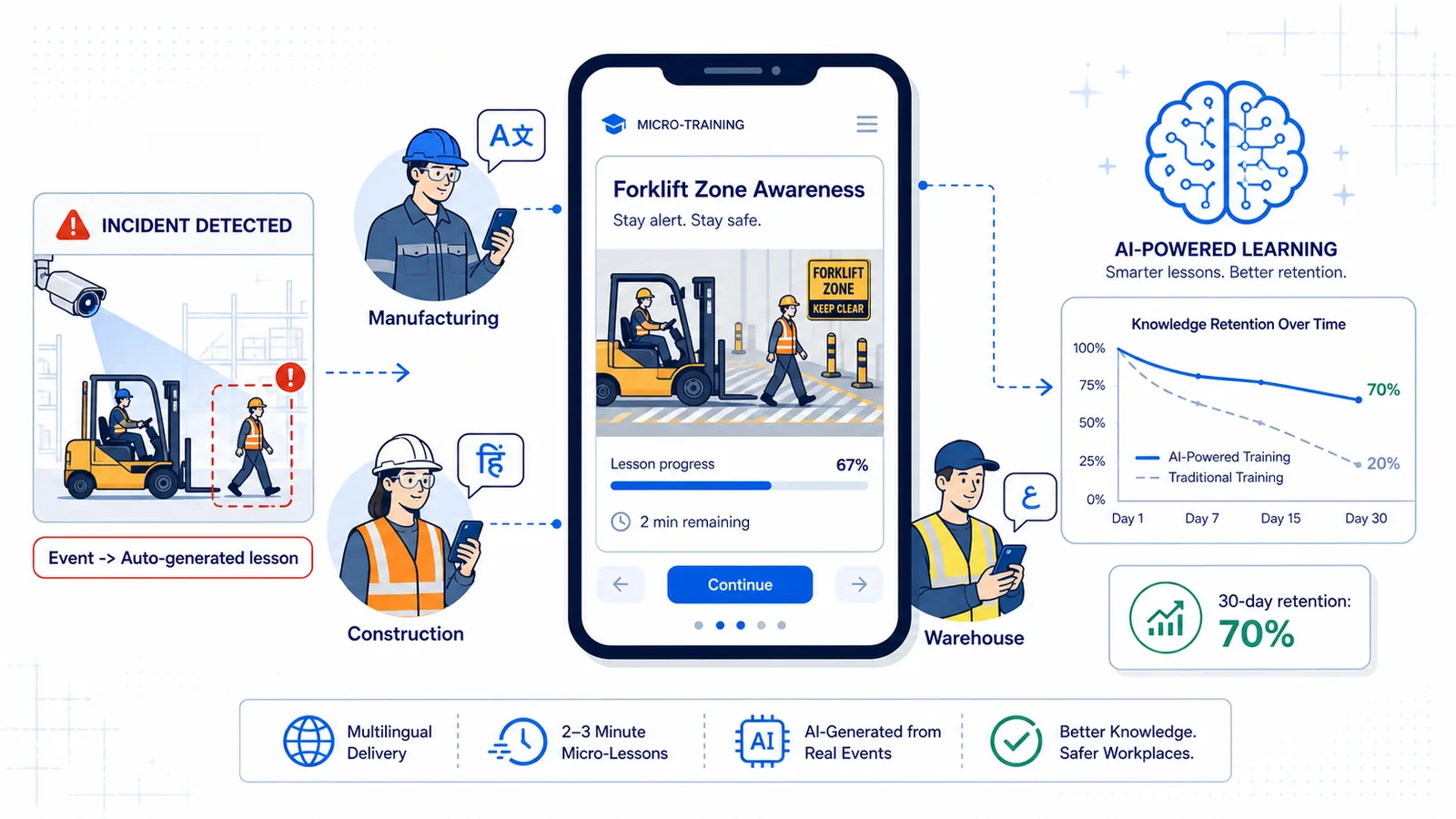
Frontline workers — the people operating heavy machinery, managing hazardous materials, and keeping production lines moving — face the highest injury rates in any workforce category. Yet the training designed to protect them often misses the mark. Completion rates drop. Knowledge fades within days. And workers who don't speak English as a first language are frequently left behind.
The problem isn't the workers. The problem is the training model.
Traditional safety training was built for office environments: scheduled sessions, PowerPoint decks, hour-long modules, and annual refreshers. Frontline work doesn't operate on that schedule. A shift supervisor can't pull twelve operators off a production line for a two-hour classroom session. A warehouse associate who speaks Somali isn't going to retain critical hazard information from a fast-paced English video. And a generic video about ladder safety, filmed in a studio, won't resonate with someone who works at a facility where the real risks are chemical exposure and forklift traffic in narrow corridors.
This is the frontline training crisis: low completion, low retention, and language barriers that leave your most vulnerable workers unprotected. And it's why a growing number of industrial operations are moving from static learning management systems to adaptive, incident-based micro-training — the kind that powers SAFVR's IMPROVE engine.
Why Frontline Safety Training Fails Today
If your completion rates are below 70% or your workers can't recall a training module three weeks after taking it, you're not alone. Three structural problems undermine most frontline training programs:
Time Constraints
Frontline work is production-driven. Every minute a worker spends in training is a minute not spent on the line, in the field, or at the station. Traditional LMS modules run 30 to 90 minutes. That's untenable for most shift-based operations. According to a 2023 industry survey of manufacturing and logistics leaders, the most common reason for incomplete training is "lack of available time during shifts" — customer-reported barrier across multiple deployment sites.
The result? Training gets deferred, rushed, or skipped entirely. Supervisors sign off on completions they know didn't happen. And the organization carries compliance risk without the actual safety benefit.
Irrelevant, Generic Content
Most safety training libraries are built to serve the widest possible audience. A single "hazard awareness" module might cover everything from office ergonomics to chemical spills. For a frontline worker in a steel plant, that means wading through 80% irrelevant content to reach the one scenario that actually matters to them.
This isn't just inefficient. It signals disrespect. It tells the worker that the organization doesn't understand — or doesn't care about — the specific risks they face every day. When training doesn't reflect reality, workers disengage. And disengaged workers don't retain safety-critical information.
Language and Accessibility Gaps
In many industrial workforces, English is a second, third, or fourth language. Census data and labor reports consistently show that manufacturing, logistics, and construction workforces are significantly more linguistically diverse than office-based roles (third-party statistic). Yet most safety training is produced in English only, often with dense technical vocabulary, fast narration, and no subtitles.
The consequence is predictable: workers either skip the training, struggle through without comprehension, or rely on bilingual colleagues to translate — introducing errors, omissions, and liability. This isn't a worker capability problem. It's a training design problem.
What Is Adaptive Safety Training?
Adaptive safety training is a methodology that adjusts what a worker learns, when they learn it, and how the content is delivered based on their role, location, incident exposure, and language preference. It replaces the one-size-fits-all annual module with a continuous, personalized learning loop.
Here's how it differs from a traditional static LMS:
| Feature | Traditional LMS | Adaptive Safety Training |
|---|---|---|
| Content source | Generic vendor library | Site-specific, generated from actual incidents |
| Lesson length | 30–90 minutes | 2–3 minutes |
| Delivery schedule | Annual or quarterly | Triggered by real events, near-misses, and risk patterns |
| Language | Usually English only | Multilingual, localized per worker |
| Relevance | Broad, industry-level | Facility-specific, role-specific |
| Completion tracking | Checkbox compliance | Behavioral correlation and retention metrics |
The key shift is from content delivery to learning in context. Instead of asking a worker to remember a generic lesson about PPE, adaptive training delivers a two-minute module about the exact PPE violation that was detected on their line last Tuesday — with a photo of the actual location, in their preferred language, right before their next shift.
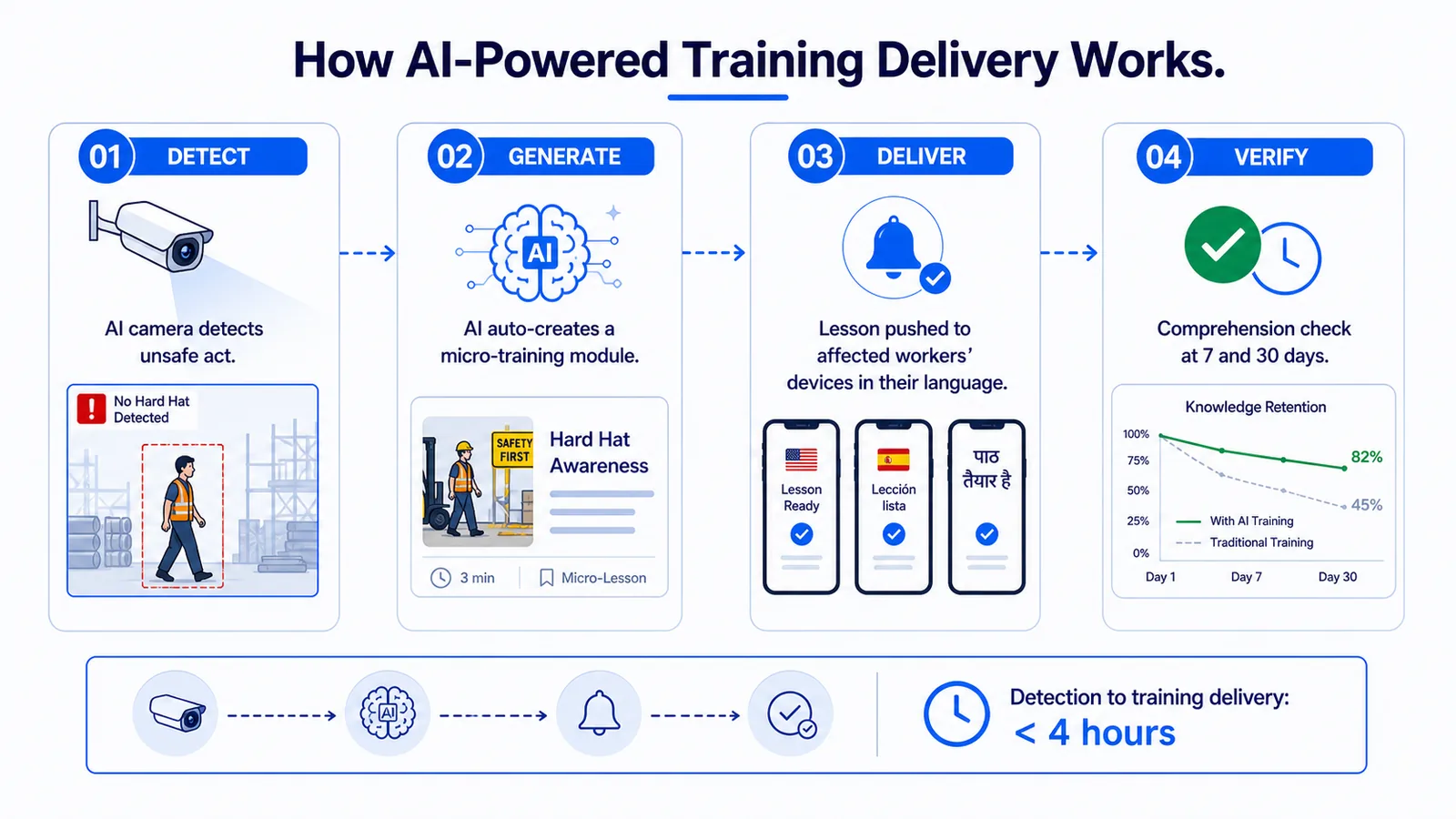
This is how SAFVR's IMPROVE phase operates: detections from existing IP cameras feed into accountable actions, and those actions generate targeted micro-training modules that adapt to each site, each shift, and each worker.
Site-Specific: Training for Your Actual Risks
Generic hazard icons don't save lives. Knowing that your facility's east-wing forklift corridor has a documented blind spot at the 2:00 p.m. shift change — and seeing a module that shows exactly that intersection with your actual layout — does.
Site-specific safety training is the practice of building lessons from real conditions, real incidents, and real footage from your facility. It replaces stock photography with actual environments. It replaces theoretical scenarios with events that happened on your floor last month.
This matters because of a well-documented learning principle: context-dependent memory. People retain information better when it's learned in the same context where it will be applied (third-party statistic: cognitive psychology research on encoding specificity). A worker who sees a training module filmed in their exact aisle, referencing their exact equipment, and citing an incident from their own shift is far more likely to recall and apply that knowledge than someone watching a generic video about "warehouse safety."
Site-specific training also builds trust. When workers see that the organization understands and documents their specific risks — not just industry averages — they're more likely to engage with the training and report hazards themselves. It turns training from a compliance exercise into a shared safety culture.
The Power of Short-Form, Incident-Based Lessons
The science of learning retention supports brevity. Microlearning — short, focused lessons delivered at the point of need — consistently outperforms long-form training on knowledge retention and application (third-party statistic: published research on microlearning efficacy in industrial settings).
But not all microlearning is equal. The most effective frontline safety lessons share three characteristics:
-
Incident-based: The lesson is triggered by a real event — a near-miss, a detection, a hazard observation — not a calendar date. This creates urgency and relevance.
-
Visual and concrete: The module shows the actual location, the actual equipment, or a realistic recreation of the incident. Abstract warnings are forgettable. Specific images stick.
-
Actionable: The worker leaves with a clear behavioral change — "Check this blind spot before entering," "Verify lockout at this panel," "Report spills in this zone immediately."
Two to three minutes is enough time to show the incident, explain the risk, and prescribe the behavior. It's short enough to complete during a shift change, a break, or before clocking in. And because the content is generated automatically from detections and actions, the training library grows with every event — creating a living, site-specific curriculum without manual course authoring.
This is safety training automation at scale: not replacing trainers, but freeing them from content production so they can focus on coaching, verification, and culture.
Multilingual & Accessibility Considerations
Language barriers in safety training aren't a side issue — they're a central failure point. If a significant portion of your workforce can't fully comprehend a training module, you don't have a training program. You have a liability document.
Effective multilingual safety training goes beyond simple translation. It requires:
- Localized content: Not just translated words, but culturally appropriate examples, units of measurement, and regulatory references.
- Native narration: Where possible, spoken narration in the worker's language, not just subtitles on English audio.
- Readable text: Short sentences, simple structure, and minimal jargon — especially important when workers may be literate in their first language but struggle with technical English.
- Visual-first communication: Where language is a barrier, imagery, diagrams, and video become the primary teaching tools.
Accessibility also extends to delivery format. Some workers may not have reliable smartphone access on the floor. Others may share devices. The training platform must support kiosk mode, shared tablets, QR-code access at workstations, and offline completion with sync — meeting workers where they are, not demanding they adapt to a corporate IT standard.
Measuring Training Effectiveness on the Frontline
Completion percentage is a start, but it's not enough. To know whether your frontline worker safety training is actually working, you need to track metrics that connect learning to behavior and behavior to outcomes.
| Metric | What It Measures | Why It Matters |
|---|---|---|
| Completion Rate | Percentage of assigned modules finished | Baseline engagement indicator; below 70% signals access or time barriers (customer-reported benchmark) |
| Time-to-Complete | Average minutes per module | Flags modules that may be too long or too difficult; targets 2–3 minutes for micro-training |
| Knowledge Retention Score | Quiz results at 1 day, 1 week, 1 month | Measures whether learning sticks; sharp drop-off indicates content or delivery issues |
| Incident Correlation | Repeat incidents in trained topics | The ultimate test: did training reduce the specific behavior it targeted? |
| Near-Miss Reporting Rate | Voluntary hazard reports per worker per month | Indicates psychological safety and engagement; engaged workers report more, not fewer, hazards |
| Behavioral Observation Score | Supervisor-observed compliance in trained areas | Ground-truth validation that training translates to on-floor behavior |
The most important insight from this table: correlation beats completion. A training program with 95% completion and no change in incident rates is a compliance success and a safety failure. The goal isn't to check boxes. It's to change behavior.
From Training to Behavior Change
Training teaches knowledge. Behavior change requires habit formation. And habit formation in safety-critical environments depends on three psychological levers:
Repetition in Context
One exposure to a safety lesson isn't enough to rewire behavior. The lesson needs to be reinforced at the point of decision — the moment a worker is about to enter a confined space, start a forklift, or handle a chemical. Adaptive training achieves this by delivering reminders and refreshers triggered by location, shift, and recent incident exposure.
Social Proof and Norms
Workers take cues from their peers and supervisors. When micro-training is coupled with visible safety data — dashboards showing team completion rates, shared near-miss learnings, supervisor acknowledgments — it reinforces that safety is a collective priority, not an individual chore.
Immediate Feedback
The faster the loop between action and consequence, the stronger the learning. A worker who receives a two-minute refresher on lockout procedures the same day a violation was detected in their zone experiences a tight feedback loop. That immediacy is far more effective than a quarterly reminder about procedures they last thought about months ago.
This is where training connects to the broader safety intelligence cycle. Detection feeds action. Action feeds training. Training feeds prevention. The loop only works when each phase is connected — and when training is treated as a behavior-change tool, not a compliance checkbox.
Ready to see adaptive safety training in action? Start a 30-day safety intelligence pilot and experience how site-specific, incident-based micro-training is generated automatically from your facility's actual conditions — no new hardware, no rip-and-replace, no generic content.
Frequently Asked Questions
How long should frontline safety training modules be?
For maximum retention and completion, frontline micro-training modules should be 2 to 3 minutes. This aligns with research on working memory and attention spans in industrial settings (third-party statistic). Longer modules see sharp drop-offs in completion, especially when workers must fit training around shift responsibilities.
Can safety training really be generated automatically from incidents?
Yes. Modern Safety Intelligence Platforms can convert detections — such as PPE violations, unsafe acts & conditions, or hazard observations — into structured micro-training modules. The module references the actual incident context, location, and relevant procedure, then delivers it to affected workers in their preferred language. This is the core of adaptive safety training.
What if our workforce speaks multiple languages?
Multilingual delivery is essential, not optional. Effective programs provide localized narration, translated text, and visual-first content for workers with varying literacy levels. The training platform should support language selection per worker and allow updates without rebuilding entire courses.
How is adaptive training different from a standard LMS?
A standard LMS delivers the same content library to all users on a fixed schedule. Adaptive training adjusts content, timing, and language based on each worker's role, location, incident exposure, and learning history. It turns training from a scheduled event into a continuous, context-aware system.
Does short-form training meet compliance requirements?
Short-form training can meet compliance requirements when it covers mandated topics, tracks completion with timestamps, and maintains audit trails. However, regulatory requirements vary by jurisdiction and industry. Safety training should be designed to support compliance, not guaranteed to satisfy it without review against your specific regulatory obligations. Always validate your program against applicable OSHA, ISO 45001, or local standards.
Conclusion
Frontline worker safety training doesn't fail because workers don't care. It fails because the training model wasn't built for their reality: limited time, specific risks, diverse languages, and the need to turn knowledge into action the moment they step onto the floor.
What works is adaptive: short, site-specific, incident-based modules delivered in the right language at the right moment. It respects the worker's time. It reflects their actual environment. And it closes the dangerous gap between what workers are taught and what they actually do.
If your current training program is still running on annual LMS modules and generic video libraries, it's time to evolve. The tools exist. The intelligence exists. And the frontline workforce deserves safety training that was built for them — not adapted from an office playbook.
Start your 30-day pilot today and see how site-specific, AI-generated safety training transforms frontline engagement and risk reduction across your operation. Or explore the full SAFVR platform to learn how detection, action, improvement, and prevention work together as one continuous system.
Related Reading
- Incident-Based Micro-Training Explained — How to turn real-time near-miss detections into targeted microlearning delivered at the moment of relevance.
- Safety Training Retention Guide — The science of the forgetting curve and why spaced repetition outperforms annual training sessions.
- PPE Detection AI Guide — The detection layer that feeds site-specific training: how AI identifies the compliance gaps your training should target.