
Last updated: 2026-04-25
Quick Answer
Incident-based micro-training is a safety learning method that automatically generates short, targeted training modules from real incidents and near-misses at your facility. Instead of generic annual training, workers receive bite-sized lessons triggered by actual events—improving retention, relevance, and behavior change. This approach is central to site-specific safety training and adaptive safety training systems like SAFVR's AURA engine.
Introduction: The Problem with Annual Safety Training
Most industrial safety programs still follow a familiar pattern: a mandatory all-hands training session at the start of the year, a sign-off sheet, and a hope that the information sticks for the next twelve months.
For Training Managers and EHS Directors, the frustration is well known. You invest hours developing content, pull workers off the floor, and deliver the same material to everyone—regardless of their role or the specific risks they face. By the time an incident happens in October, the training from January is a distant memory.
The result? Low engagement, poor knowledge retention, and a disconnect between what workers learn and what they actually encounter on the job. Frontline workers sit through hours of content that may not apply to their daily tasks. Supervisors struggle to prove that training translates into safer behavior.
This is where incident-based micro-training changes the equation. Rather than treating training as a calendar event, it treats every near-miss and observation as a learning opportunity—delivered in the moment, in context, and in a format the brain actually retains.
What Is Incident-Based Micro-Training?
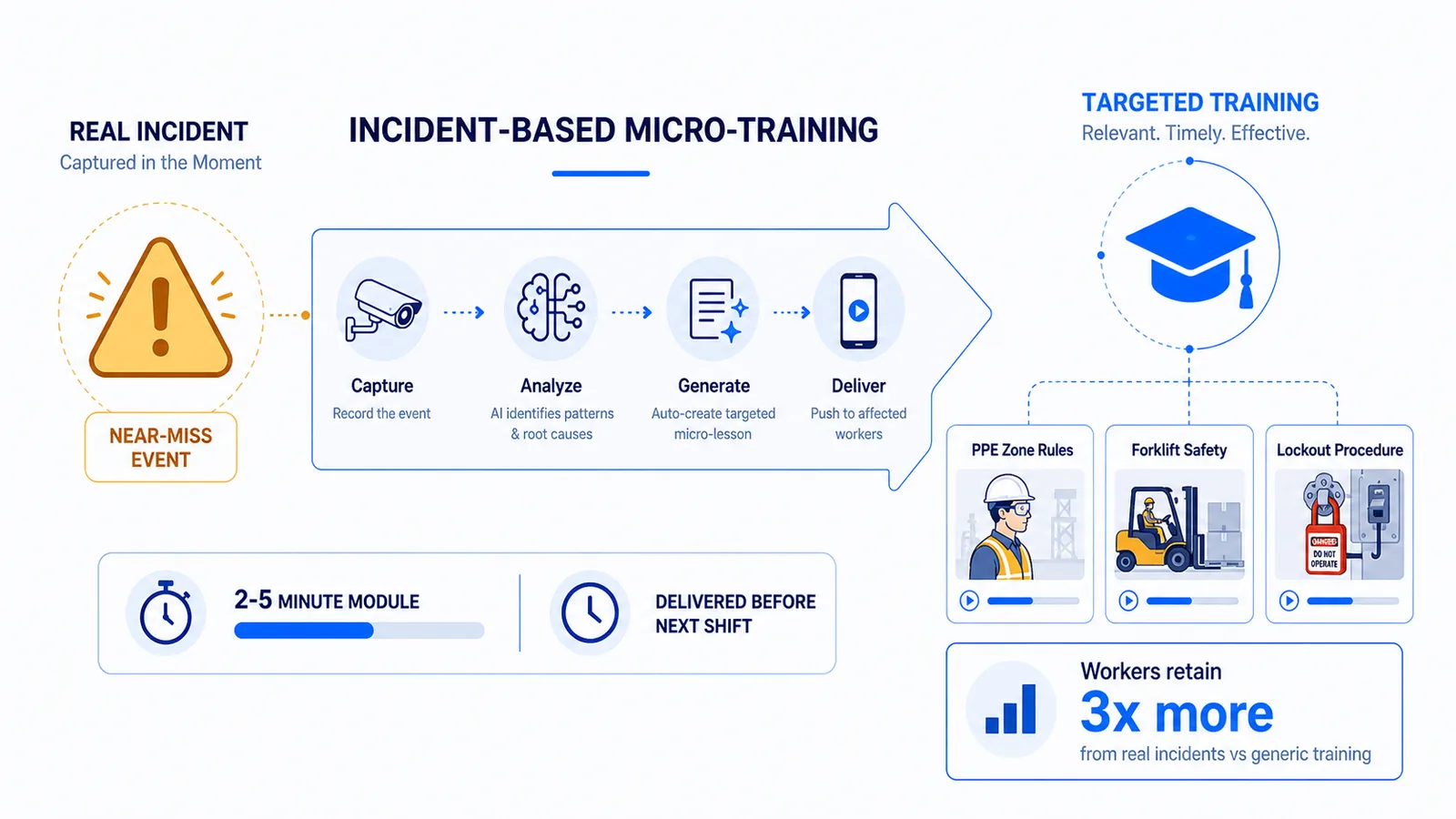
Incident-based micro-training is an approach that generates short, targeted training modules from real safety events at a specific worksite. Instead of generic courses, workers receive lessons directly tied to incidents, near-misses, or detected unsafe acts & conditions that occurred on their own floor, in their own shift.
The key distinction is site-specific relevance. A warehouse worker receives training based on a pallet-rack near-miss that happened in their aisle last Tuesday—not a generic case study from a corporate handbook.
How It Differs from Traditional Training
| Element | Traditional Annual Training | Incident-Based Micro-Training |
|---|---|---|
| Trigger | Calendar date | Real incident or near-miss |
| Content | Generic, one-size-fits-all | Site-specific, event-based |
| Duration | 30–60 minutes (or longer) | 2–5 minutes per module |
| Delivery | Classroom or LMS module | Mobile, tablet, or workstation |
| Frequency | Annual or quarterly | Continuous, as events occur |
| Personalization | None—same for all roles | Adaptive by role, location, incident type |
| Measurement | Completion rates | Behavior change and incident reduction |
This approach is a core capability of SAFVR's IMPROVE phase—where detections become lessons, and lessons become measurable behavior change. Learn more about incident-based micro-training.
Why Traditional Safety Training Fails
Training Managers and HR Leaders know the cycle. You schedule the session. You track completions. You check the compliance box. But the fundamental problems with long-form, event-based training persist across industries:
The Forgetting Curve Is Real
Within 30 days of a traditional training session, employees forget up to 70% of what they learned (third-party statistic: Ebbinghaus forgetting curve research, applied to workplace training studies).
Low Contextual Relevance
A worker in a cold-storage warehouse and a worker in a stamping plant may sit through the same slide deck on PPE compliance. Neither receives training tailored to the specific hazards, layout, or incident history of their actual workplace.
Disruption and Resistance
Pulling frontline workers off the floor for an hour-long session creates operational friction. Supervisors resist. Workers disengage. And the training is often viewed as a compliance checkbox rather than a meaningful safety tool.
No Closed Loop
Traditional training sits apart from incident data. There is no automatic mechanism that says: "A near-miss happened here—let's teach the lesson now." The result is a lag between incident and education, often weeks or months.
The Science Behind Microlearning
Microlearning—delivering content in short, focused bursts—has been extensively studied in cognitive science and workplace education. The findings consistently favor smaller, spaced doses over single large sessions.
Retention Data (Source-Labeled)
| Finding | Statistic | Source Label |
|---|---|---|
| Microlearning improves retention by 17% over traditional long-form training | 17% retention lift | Third-party statistic: Journal of Applied Psychology meta-analysis |
| Workers are 50% more likely to engage with training under 5 minutes | 50% higher engagement | Third-party statistic: Workplace learning platform benchmark data |
| Spaced repetition increases long-term retention by 200% compared to cramming | 2x retention improvement | Third-party statistic: Cognitive science research (spacing effect) |
| 94% of learning professionals say microlearning is preferred by modern workers | 94% preference rate | Third-party statistic: Industry learning survey |
| Bite-sized content is 58% more engaging than traditional courses | 58% engagement increase | Third-party statistic: Corporate e-learning benchmark report |
The mechanism is straightforward: the brain encodes short, relevant, emotionally salient experiences more effectively than long, abstract ones. A near-miss that happened yesterday on your own line is emotionally salient. A five-minute module delivered today encodes far better than a 45-minute annual review.
How Incident-Based Micro-Training Works
The process follows a clear, repeatable cycle that connects what happened on the floor to what workers learn next. Here is how it operates in practice:
Step 1: Detect the Event
A safety event is identified—through computer vision detection, a near-miss report, an unsafe act observation, or a permit-to-work flag.
Step 2: Classify and Contextualize
The incident is categorized by type, severity, location, and involved roles. Because the system operates with site-specific safety training logic, the context is drawn from the actual facility—not a generic template.
Step 3: Generate the Micro-Module
A short training module is automatically generated or selected from a library. The module references the actual incident, explains the hazard, demonstrates correct behavior, and includes a brief knowledge check. Duration: 2–5 minutes.
Step 4: Deliver to the Right Workers
The module is pushed to the affected workers' devices—tablet, workstation terminal, or mobile. Delivery is adaptive by role, and multilingual support ensures comprehension across diverse workforces.
Step 5: Confirm Understanding
Workers complete a brief assessment. Completion is logged, and supervisors see who has been trained.
Step 6: Close the Loop
Training data feeds back into the safety intelligence system. If similar incidents recur, the system flags a gap. If completion is high and incidents drop, the organization has proof that learning is working.
This six-step process is what makes adaptive safety training genuinely adaptive—it learns from your site, for your workers, in real time.
5 Real-World Examples
Incident-based micro-training is already delivering results across industrial sectors. Here are five scenarios that illustrate how it works in practice:
1. Manufacturing: Machine Guarding Near-Miss
A vision system detects a worker reaching around a guarding panel on a stamping press. Within 24 hours, operators on that line receive a three-minute module on guarding protocols. The next audit shows zero repeat violations.
2. Warehousing: Forklift Pedestrian Close Call
A forklift comes within proximity of a pedestrian in a narrow aisle. All forklift drivers on that shift receive micro-training on aisle navigation and pedestrian right-of-way—tailored to the warehouse's actual layout.
3. Construction: PPE Detection Trigger
A computer vision system identifies a worker entering a hard-hat-required zone without head protection. Instead of a generic PPE lecture, the worker receives a two-minute module with site-specific entry-point rules and a map of the zone.
4. Food Processing: Slip Risk After Spill
A near-miss report notes a slip hazard near a packaging line. All workers in that area receive adaptive safety training on spill response and footwear requirements—delivered in their preferred language and referencing the exact location.
5. Logistics: Ergonomic Lifting Flag
An unsafe act observation captures a worker lifting above shoulder height. The system generates a micro-module on proper lifting technique, specific to the package weights and shelf heights at that distribution center.
Ready to turn your incidents into training? Start a 30-day safety intelligence pilot and see incident-based micro-training in action at your facility.
Measuring the Impact of Micro-Training
Training Managers and EHS Directors need proof that micro-training delivers more than just completion rates. Here are the metrics that matter:
| Metric | What It Measures | How to Track It |
|---|---|---|
| Training Completion Rate | Percentage of assigned modules completed | LMS or safety platform dashboard |
| Time-to-Completion | Average minutes from assignment to finish | Platform analytics |
| Knowledge Retention Score | Assessment results 7–30 days post-training | Follow-up quizzes or observations |
| Repeat Incident Rate | Same hazard type recurring after training | Incident tracking system |
| Behavior Change Observations | Supervisor-confirmed safer practices | Mobile observation app or safety walks |
| Training-Incident Correlation | Reduction in incidents after training cohorts | Cross-reference training and incident logs |
| Worker Engagement Score | Voluntary replays, feedback, or shares | Platform interaction data |
| Compliance Coverage | % of workforce trained on current hazards | Training matrix vs. active hazard register |
Organizations using site-specific safety training tied to real incident data typically see stronger performance across these metrics than those relying on generic annual programs. When training is triggered by actual events, you can draw a straight line from lesson to outcome.
From Incident to Prevention: The Closed Loop
The most powerful aspect of incident-based micro-training is not the training itself. It is the closed loop it creates across the safety operation.
Here is how the loop works in SAFVR's AURA engine:
- DETECT — A hazard, unsafe act, or condition is identified by computer vision or reported by a worker.
- ACT — Alerts fire, workflows trigger, and the right people are notified in real time.
- IMPROVE — The incident feeds into the micro-training engine. Targeted lessons are generated and delivered to the workers who need them most. This is incident-based micro-training in action.
- PREVENT — Patterns emerge. The system surfaces leading indicators—showing which hazards recur and where predictive risk is building.
The result is a safety program that gets smarter over time. Every incident teaches. Every lesson reduces risk. Every data point feeds prevention.
This is the shift from reactive reporting to proactive protection.
Explore the full SAFVR platform to see how DETECT, ACT, IMPROVE, and PREVENT work together.
Frequently Asked Questions
What is incident-based micro-training?
Incident-based micro-training is a safety learning approach that automatically generates short, targeted training modules from real incidents and near-misses at a specific facility. Workers receive bite-sized lessons directly related to events that happened on their site, improving relevance and retention compared to generic annual training.
How is micro-training different from e-learning?
Traditional e-learning typically delivers long, standardized courses through a learning management system. Micro-training delivers short modules (usually 2–5 minutes) that are triggered by specific events, adaptive to the learner's role and location, and focused on a single learning objective at a time.
Can micro-training replace annual safety training?
Incident-based micro-training is designed to supplement and strengthen—not necessarily replace—annual compliance training. Many organizations use micro-training for continuous, site-specific skill building while maintaining annual sessions for regulatory requirements. The combination often produces better outcomes than either approach alone.
How quickly can micro-training be deployed after an incident?
With an automated safety intelligence platform, micro-training modules can be generated and delivered within hours of an incident. In some cases, workers receive the lesson before their next shift—closing the gap between event and education dramatically compared to traditional scheduling.
Does micro-training work for non-English-speaking workforces?
Yes. Effective adaptive safety training platforms include multilingual delivery, allowing workers to receive modules in their preferred language. This is especially important for frontline worker safety training in diverse industrial workforces where comprehension directly impacts safety outcomes.
Conclusion
Annual safety training has a place, but it cannot be the only tool in your program. Workers who face hazards every day need learning that is timely, relevant, and tied to the actual risks they encounter. Incident-based micro-training delivers exactly that—turning near-misses into targeted lessons, and lessons into measurable behavior change.
For Training Managers tired of low engagement, for EHS Directors seeking proof of impact, and for HR Leaders committed to frontline development, the shift to adaptive, site-specific micro-training represents a practical path forward.
The question is not whether your workers need more training. It is whether they need better training—delivered at the moment it matters most.
Start Building a Smarter Safety Program
- Start a 30-day pilot — See incident-based micro-training in action at your facility, risk-free.
- Explore the IMPROVE phase — Learn how SAFVR turns detections into site-specific training.
- View the full platform — Discover how DETECT → ACT → IMPROVE → PREVENT works as one system.
Related Reading
- Safety Training Retention Guide — The neuroscience behind why micro-training works: spaced repetition, context-dependent encoding, and the forgetting curve.
- Frontline Worker Safety Training AI — Broader look at AI-powered training for frontline workers, including multilingual delivery and adaptive content.
- Near-Miss Trend Analysis Guide — The near-miss data that triggers incident-based micro-training — how to capture it systematically.